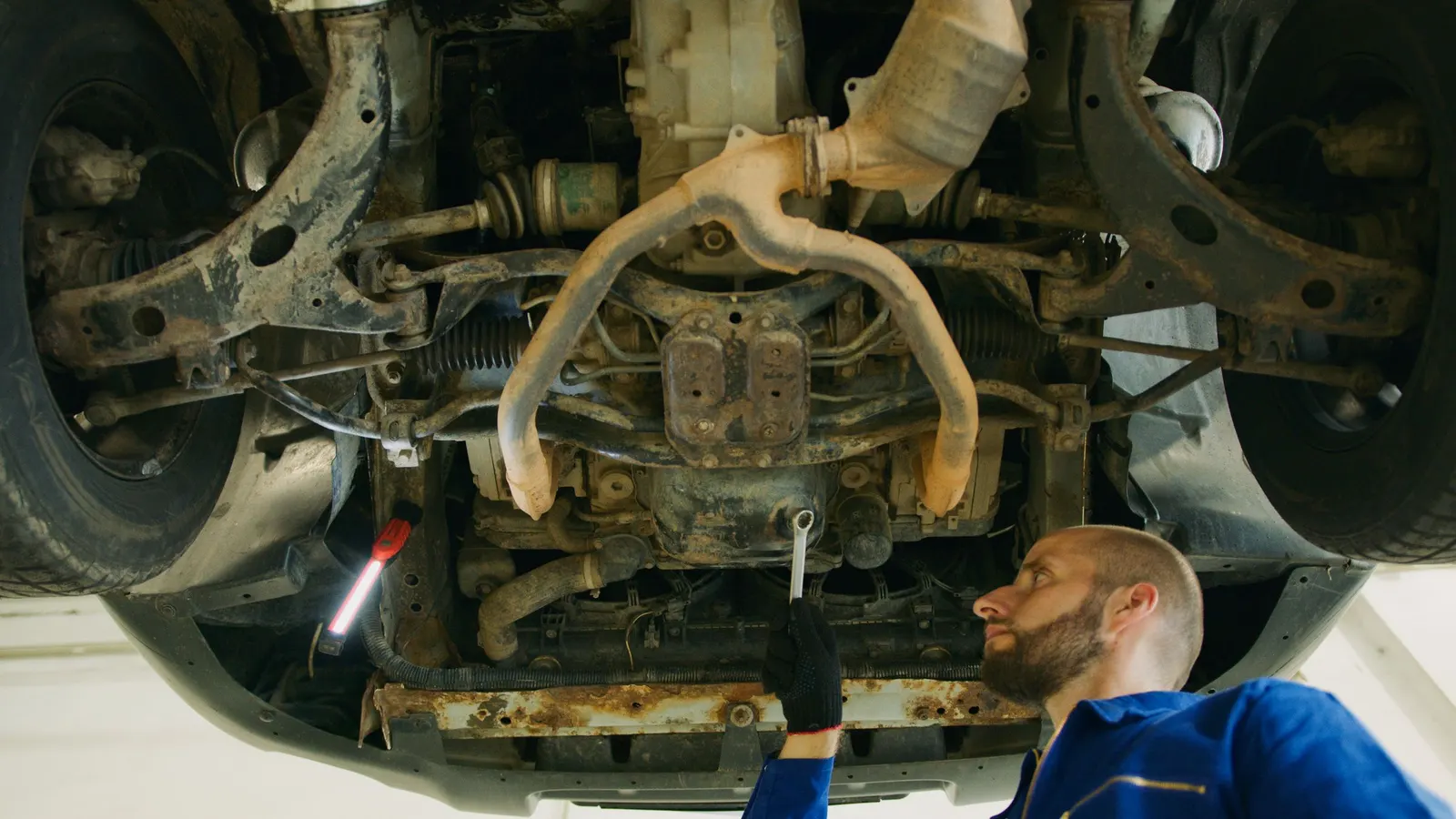
A transmission fluid leak usually shows up as red or reddish-brown drops under the middle of the car on a rear-wheel-drive vehicle, or toward the side where the transmission sits on a front-wheel-drive one. The three most common sources are the pan gasket, the cooler lines that run to the radiator, and the transmission's seals. A few spots a week means book a check soon. A puddle, slipping or a burning smell means stop driving it.
This guide is about finding the leak: what the color tells you, where under the car it lands, how far you can drive, and what stop-leak can and cannot do. If the fluid is already low and the car is shifting badly, our low transmission fluid symptoms guide covers that side.
Transmission fluid leak at a glance
- What it looks like: red or brown, thick, with a petroleum smell, dripping around the middle of the car (AAA).
- Most common sources: the pan gasket, the cooler lines and hoses, and worn seals (Fel-Pro).
- Can you drive? A slow seep with a correct fluid level, a short trip to a shop. A puddle, slipping, late engagement, a burning smell or a warning light: stop.
- Will it stop on its own? No. Fel-Pro says a leak won't fix itself and can damage the transmission if you wait.
- Stop-leak: can help a hardened rubber seal. It cannot fix anything cracked, torn or loose.
- Your rights in California: a written estimate before any work, and a teardown estimate if the transmission has to come apart (Bureau of Automotive Repair).
Is It Transmission Fluid? Check the Color, Feel and Smell
Automatic transmission fluid is dyed red on purpose. Oil maker AMSOIL says the red dye is added to prevent confusion with motor oil, and Brake & Front End magazine reports that manufacturers started adding it in the late 1960s so technicians could tell the two apart and leaks were easier to diagnose. That makes the color a good first clue, but not proof: power steering fluid and some coolants can be red too.
Put a piece of white paper or cardboard under the drip, then look at the spot in daylight and rub a drop between your fingers. AAA's guide to car leaks describes each fluid like this:
Swipe the table sideways to see where each fluid drips.
| Fluid | Color and feel | Smell | Where it drips |
|---|---|---|---|
| Transmission fluid | Red or brown; thick | Petroleum, gas-like | Around the middle of the car |
| Power steering fluid | Red, pink or brown; thin | Burnt marshmallows, a little sweet | Front, near the reservoir or the hoses to the steering rack |
| Engine oil | Black, amber or brown; thick and oily | Burnt, like cooking oil | Under the engine: oil pan, valve covers, gaskets and seals |
| Coolant | Often green; also orange or pink, and some are dyed red | Sweet | Front, around the radiator and its hoses |
| Brake fluid | Clear, light brown or light yellow; slippery and very slimy | Slightly fishy | The brake lines, the reservoir or the master cylinder |
| A/C water | Clear; watery | None | Under the A/C area or the exhaust, after running the A/C. Normal |
The coolant row comes from Mobil's coolant leak guide (a green puddle, the radiator), AAA Club Alliance (some coolants are dyed red) and our own fluid leaks page (green, orange or pink, sweet-smelling). Everything else in the table is from AAA's guide to automotive leaks.
Two more color clues:
- Brown is not automatically burnt. Transmission fluid can darken with heat. Oil analysis lab Blackstone Laboratories writes about mechanics who thought engine oil had been added to a transmission, when it was actually ATF that had turned brown from excess heat. A burnt smell is the warning sign, and our burnt transmission fluid guide covers it.
- CVT fluid may not be red. Blackstone notes that CVT fluids tend to be dyed blue or green to tell them apart from regular red ATF. A green or blue drip under a car with a CVT can still be transmission fluid.
Where Is the Drip? Find the Leak by Its Spot Under the Car
Where the fluid lands is often a better clue than the color. Fel-Pro says transmission spots can be in the center of the vehicle on rear-wheel drive, or on the side of the vehicle where the transmission is located on front-wheel drive. From there, the spot narrows down the part:
| Where the spot is | Likely source | What reaching it involves |
|---|---|---|
| At the very front, near the radiator | A transmission cooler line or its fitting at the radiator | The lines attach to the radiator's side tank with threaded fittings, outside the transmission |
| Along the path of a line or hose | A cracked hose, a loose connection, or a crimp clamp where a rubber hose meets a metal line | Replacing the hose or line section |
| Directly under the transmission | The pan gasket, the drain plug, or a pan dented or cracked by road debris | Removing the pan, cleaning the surfaces, a new gasket, then refilling and testing |
| Where the engine and transmission meet | The front pump seal, where the torque converter goes into the transmission | The transmission has to come out |
| At a front wheel (front-wheel drive) | An axle seal where the drive axle leaves the transaxle | Taking apart the wheel end and pulling the drive axle out to reach the seal |
| At the back of the transmission (rear-wheel drive) | The output shaft seal, where the driveshaft connects | Sliding the driveshaft out of the seal first |
| Behind the transmission on a 4WD or AWD truck or SUV | The transfer case, which is a separate unit from the transmission | Checking the transfer case and its seals. See transfer case repair |
Sources for the table: cooler lines connect the transmission to the radiator or a separate cooler, and crimp-style clamps on rubber hoses can start to leak with age (Fel-Pro); many radiators also cool the transmission fluid, with the transmission lines attached to the radiator's side tank (Mobil); the front pump seal, output shaft seal, pan gasket, cooler line fittings and the axle seals on front-wheel-drive transaxles are listed as common leak points by seal-treatment maker Toralin; the pan gasket steps are from our fluid leaks page; O'Reilly Auto Parts says an axle seal job means taking apart the wheel end and removing the shaft; Transmissions.biz shows the driveshaft coming out before an output shaft seal; and a technical bulletin from TEAE on a front pump seal leak begins with one instruction: "Remove transmission."
Why the Drip Can Fool You
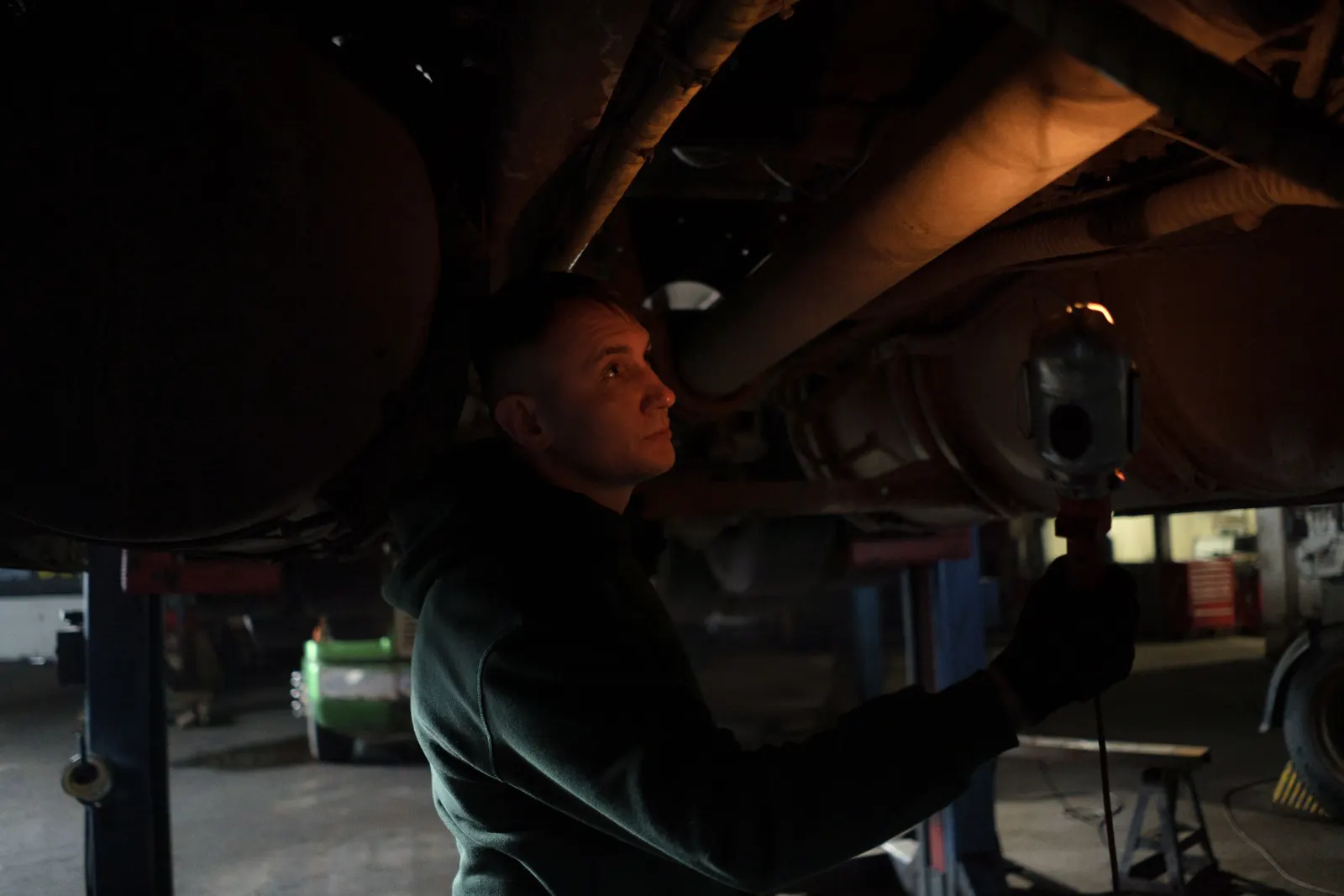
Fluid runs along lines, brackets and the bottom of the transmission before it falls, so the spot on the ground is where it drips, not always where it leaks. The method Mobil describes for oil pan leaks works for transmission fluid too: clean the area, drive, and when fluid reappears, follow the trail to its highest point. A shop does the same thing with the car on a lift and a light.
One more look-alike: an engine rear main seal leaks at the same joint between the engine and the transmission as a front pump seal, as our oil leak page explains. Color tells them apart. Engine oil is black, amber or brown; transmission fluid is red or reddish-brown. Our oil leak repair page covers the engine side.
Can You Drive With a Transmission Fluid Leak?
Short answer: a slow seep with the fluid at the right level can usually be driven to a shop, carefully. Jiffy Lube puts it this way: it may be safe to drive with a leaking transmission, but it is not advisable, and you shouldn't put off fixing it. The reason to hurry is heat. Blackstone Laboratories says that in its experience heat is what kills most transmissions, and that the number-one cause of transmission fluid getting too hot is fluid volume lost to a leak: less fluid has to do the same work and heats up faster.
Stop driving and call a shop or a tow if you see any of these:
- A puddle, not a few spots, under the car after it sits
- The engine revs up without the car speeding up the way it should (slipping)
- A pause before the car moves after you shift into Drive or Reverse
- Harsh or banging shifts, or a transmission stuck in one gear (limp-home mode)
- A burning smell, a whine or a hum that wasn't there before
- A transmission or check engine warning light
Those warning signs come from Jiffy Lube, AAA Club Alliance, Fel-Pro and our transmission repair page (the warning light). AAA adds that a leaking transmission can let dirt and debris in, and that left alone a leak can lead to catastrophic failure of the whole transmission.
How Long Can You Drive With a Transmission Leak?
Nobody can give you a number of miles, because it depends on how fast it is leaking and how much fluid your transmission holds. What you can do is watch the level. AAA Club Alliance recommends checking it, topping up with fresh fluid, and continuing to monitor: if the level drops again, see your mechanic. If you have to top up between checks, it is time to get it fixed rather than keep adding fluid.
What Causes a Transmission Fluid Leak
- A worn pan gasket. The gasket between the pan and the transmission case wears with heat and age, and it is one of the most common leaks. Some manufacturers use RTV sealer instead of a gasket, which also breaks down over time (Fel-Pro).
- Cooler lines and hoses. A crack or a loosened connection in the lines to the radiator or cooler can leak, and rubber hoses held by crimp-style clamps can take a set and start seeping at the connection (Fel-Pro).
- Seals. Heat and skipped fluid maintenance wear out the seals around the shafts that go in and out of the transmission (Fel-Pro).
- A loose drain plug or damaged pan. A plug that was not tightened properly, or a pan hit by road debris, can drip right after a service or right after an impact.
- How the car is driven. Jiffy Lube lists hard stops and starts, skipped maintenance, and heavy loads such as towing as things that raise the risk of a leak.
Symptoms of a Transmission Fluid Leak
The first sign is usually spots on the driveway. Fel-Pro says reddish-brown stains on the garage floor or driveway are often your first sign of a problem, and that manual gearboxes may leave light brown or reddish-brown stains. Once enough fluid is gone, you start to feel it:
- Delayed engagement when you put it in gear
- Slipping: engine revs rise without the car accelerating normally
- Harsh engagement or rough shifting
- New noises, humming or a burning smell
- Overheating, or limp-home mode that holds one gear
- On a manual: a noisy gearbox or one that is hard to shift
Sources: Jiffy Lube, Fel-Pro and AAA Club Alliance. If you are already feeling these, read our low transmission fluid symptoms guide before you drive much further.
Checking the Fluid Level the Right Way
Low fluid confirms a leak, but checking it is not as simple as it used to be. Fel-Pro notes that many newer vehicles do not have a transmission dipstick, or need to be raised to check the level, and that manual gearboxes also have to be raised. If your car has a dipstick, our step-by-step guide to checking transmission fluid shows how to read it.
Topping up only helps if you use the right fluid. Brake & Front End reports there are more than a dozen types of ATF today, and that additives can make up as much as 25% of the fluid. Blackstone Laboratories describes transmissions that burned up because the wrong ATF was added. Use the fluid named in your owner's manual, and if you can't find it, ask a shop before you pour.
Does Transmission Stop Leak Work?
Sometimes, for one kind of leak. Read what the makers themselves say:
- How it works. Bardahl says its automatic transmission stop leak works by softening and swelling rubber seals that have shrunk and hardened with mileage, and that best results come after several hundred miles of driving.
- What it can't fix. Lubegard prints it on its own label: its Seal Fixx is not effective on components that are cracked, torn or excessively damaged. A cracked cooler line, a torn gasket, a loose plug or a dented pan needs a part, not a bottle.
- How much. Lubegard's directions say one 8-ounce bottle treats a 6-quart system, at 1.3 to 1.5 ounces per quart, without going over the maximum fill level. Bardahl's directions also say not to overfill.
- When to give up on it. Bar's Leaks says that if a leak persists after a second application, mechanical attention may be required.
- Lucas Transmission Fix. Lucas says it completely eliminates most seal leaks, and on the same page says it is not recommended for CVT transmissions or dual-clutch transmissions.
Our take: stop-leak can buy time on a slow seep from an old seal. It is not a repair for a leak you can see dripping. If you have already added a treatment, tell the shop, because it changes what they see when they inspect the seals.
Automatic, CVT or Manual: What Changes
- Automatic: red ATF, and the leak points in the table above. Use the exact fluid type the manual names.
- CVT: Brake & Front End says CVTs must run a special fluid formulated for their belt drives, and that this fluid is not recommended for conventional automatics. CVT fluid may be blue or green. Lucas's transmission treatment is not recommended for CVTs. See our CVT transmission repair page.
- Manual: depending on the car, the maker may call for ATF, a gear lube or even a motor oil (AMSOIL). Leaks often look light brown or reddish-brown on the ground, and the level is checked with the car raised (Fel-Pro). See our manual transmission repair page.
What Changes the Cost of a Transmission Leak Repair
We don't publish prices, because the honest answer depends on the car in front of us. What moves the cost is how much has to come apart to reach the leak:
- Smaller jobs, done from under the car: tightening or replacing a drain plug or a line fitting, replacing a cooler hose or line section, or replacing a pan gasket.
- Medium jobs: an axle seal or an output shaft seal, where a drive axle or the driveshaft has to come off first.
- Bigger jobs: a front pump seal, because the transmission has to be removed to reach it.
- The fluid itself: some transmissions need a specific fluid and a specific procedure to set the level after the repair.
- Whether the leak already did damage: if the transmission ran low and is slipping, the repair may no longer be just a seal.
Call (707) 584-7727 with the year, make and model, where the drip is and what color it is, and we will give you a free estimate.
Your Rights in California: A Written Estimate First
California's Bureau of Automotive Repair says that, by law, a repair shop must give you a written estimate before doing any work. Under the Automotive Repair Act of 1974 you are entitled to:
- A written estimate for the repair work, listing the total for parts and labor, the parts to be used and the method of repair
- A call and your permission before any work that would cost more than the estimate
- A detailed invoice of the work done and parts supplied
- Your replaced parts back, if you ask for them when the work order is written
For complex problems such as a transmission failure, BAR explains that a shop may have to take the transmission apart to give an accurate estimate. That is called a teardown. There may be a charge for it even if you don't go ahead, and the teardown estimate must say the vehicle may not be able to be reassembled, what reassembly costs including gaskets and seals destroyed in the teardown, and how long reassembly will take. After the teardown, the shop must write a revised estimate and get your permission before repairing.
Keep Transmission Fluid Off the Driveway and Out of the Creek
Transmission fluid is petroleum-based, and in Sonoma County a drip on the street does not stay there. Permit Sonoma says anything that enters the storm drain system is discharged untreated into the creeks, streams and rivers we use for swimming, fishing, recreation and drinking water, and it names motor oil as a common storm drain pollutant. The U.S. EPA says the used oil from one oil change can contaminate one million gallons of fresh water, a year's supply for 50 people.
- Keep a drip pan or cardboard under the car until the leak is fixed.
- Don't hose fluid spots into the gutter. Soak them up and throw the material away.
- Take any drained or leftover fluid to a used oil collection site, the same way you would motor oil.
Getting a Transmission Leak Checked in Rohnert Park
Rohnert Park Transmission & Auto Repair is a transmission shop at 305 Laguna Dr in Rohnert Park, with ASE and ATRA certified technicians. We repair and rebuild automatic, manual and CVT transmissions, and our transmission cooler service covers cooler line repair. Drivers come to us from across Sonoma, Marin and Napa counties.
When you call, tell us:
- The year, make and model, and whether it is automatic, CVT or manual
- Where the spot is under the car and what color it is
- How big it gets overnight, and whether you have been topping up
- Any slipping, late engagement, burning smell or warning light
- Whether you have added a stop-leak product
We are open Mon–Thu 7:30 AM – 5:00 PM and Fri 7:00 AM – 3:00 PM. Call (707) 584-7727 for a free estimate, or see our transmission repair and rebuild page for the rest of what we do. If you are not sure the fluid is from the transmission at all, our fluid leaks page covers every kind of leak under a car.
Frequently Asked Questions
Is it safe to drive with a transmission fluid leak?
For a short trip to a shop, a slow seep with the fluid still at the right level is usually drivable. Jiffy Lube puts it as: it may be safe to drive with a leaking transmission, but it is not advisable. Stop driving if there is a puddle, the transmission slips or engages late, you smell burning, or a warning light comes on. A leak does not fix itself, and running low on fluid can ruin the transmission.
What are the symptoms of a gearbox oil seal leak?
Red or reddish-brown spots under the car are usually the first sign. As the level drops you may notice delayed engagement when you shift into gear, slipping, harsh shifts, new noises, a burning smell or overheating. Some transmissions go into limp-home mode and stay in one gear. A manual gearbox that is low on fluid can get noisy or hard to shift.
How do I know if it is transmission fluid or power steering fluid?
Check where it lands and how it feels. AAA describes transmission fluid as red or brown, thick, with a petroleum smell, dripping around the middle of the car. Power steering fluid can also be red, pink or brown, but it is thin, smells a little like burnt marshmallows and drips at the front near the steering pump, its reservoir or the hoses to the steering rack.
Why is my car leaking red fluid?
Red fluid is most often automatic transmission fluid, which is dyed red so it is not mistaken for engine oil. Power steering fluid can also be red, and AAA notes that some coolants are dyed red too. A drip under the middle of the car or near the front of the transmission points to the transmission. A drip at the very front near the radiator can be coolant or a transmission cooler line.
Does transmission stop leak work?
Sometimes, and only for one kind of leak. Stop-leak products work by softening and swelling rubber seals that have shrunk and hardened with age, and Bardahl says its best results come after several hundred miles. They do not fix a cracked line, a torn gasket, a loose drain plug or a damaged pan. Lubegard's own label says its product is not effective on parts that are cracked, torn or excessively damaged.
Does Lucas Transmission Fix work?
Lucas says it completely eliminates most seal leaks, but it also says the product is not recommended for CVT transmissions or dual-clutch transmissions. Check which transmission you have before you pour anything in, and tell your shop if you have already added a treatment.
Why does my car only leak transmission fluid when parked?
Most people only see a leak after the car has sat in one spot long enough for drops to collect. AAA Club Alliance names a red or brownish puddle under the car as the first of its three signs of a transmission fluid leak. Slide a piece of cardboard under the car overnight. Where the spots land, and how many there are by morning, tells a shop where to look and how fast it is going.
Can I fix a transmission fluid leak myself?
A loose drain plug or a loose line fitting can be a simple fix if you have the tools and the right fluid to top up. A pan gasket means draining fluid, dropping the pan and refilling to the correct level, which on many newer cars has no dipstick and has to be checked with the car raised. A front pump seal means the transmission has to come out, which is shop work.
How much does it cost to fix a transmission fluid leak?
It depends on where the leak is and how much has to come apart to reach it. A drain plug, a line fitting or a pan gasket is a smaller job done from under the car. A front pump seal means removing the transmission, which is a much bigger labor job. Call (707) 584-7727 with the year, make and model and where the drip is, and we will give you a free estimate.
Sources
- AAA, What is Leaking from Your Car: The Ultimate Guide to Automotive Leaks (2024): color, feel, smell and location for transmission, power steering, oil, brake fluid and A/C water.
- AAA Club Alliance, Leaking Transmission Fluid? 3 Sure-fire Signs (2023): red coolants, checking and monitoring the level, catastrophic failure, dirt getting in.
- Fel-Pro, Transmission Fluid Leak Symptoms: where the spots land on rear- and front-wheel drive, causes, dipstick-less cars, manual gearboxes.
- Jiffy Lube, Is Your Vehicle Leaking Transmission Fluid?: symptoms, risk factors, driving with a leak.
- AMSOIL, How motor oil color affects performance (2022) and Brake & Front End, Transmission Fluid: Just Because It's Red Doesn't Mean It's The Same (2019): why ATF is red, ATF types, additives, CVT fluid.
- Blackstone Laboratories, The Oil Report, August 2019: heat and leaks, brown ATF, wrong fluid, CVT fluid color.
- Mobil, radiator and coolant leak detection and Mobil, how to replace an oil pan gasket: coolant color, transmission lines at the radiator, following a leak to its highest point.
- Toralin, Transmission Stop Leak: common transmission leak points. TEAE Bulletin 67-6: front pump seal leak repair starts with removing the transmission. O'Reilly Auto Parts, Oil and Axle Seal Leaks and Repair and Transmissions.biz, Replace Output Shaft Seal: what axle and output seal jobs involve.
- AMSOIL, Manual vs. Automatic Transmission Fluid (2021): what manual gearboxes run.
- Stop-leak makers' own pages: Bardahl, Lubegard Seal Fixx, Bar's Leaks One Seal and Lucas Transmission Fix.
- California Bureau of Automotive Repair, A Consumer's Guide to Auto Repair (PDF): written estimates, added work, teardown estimates, returned parts.
- Permit Sonoma, Storm Water and Water Quality Programs and U.S. EPA, Managing, Reusing, and Recycling Used Oil.
Bottom Line
Red or reddish-brown drops under the middle of the car, or at the joint between the engine and the transmission, usually point to transmission fluid. Note where they land and how much there is by morning, keep the level up with the right fluid, and stop driving if it slips, smells burnt or puddles. A gasket or a line is a much smaller repair than the transmission that runs low because of one. For transmission leaks anywhere in Sonoma, Marin or Napa County, call Rohnert Park Transmission at (707) 584-7727.
Tags:
Written by
Fernando Gomez
Owner, Rohnert Park Transmission & Auto Repair
Fernando brings over 28 years of automotive repair experience to every diagnosis and repair. As the owner of Rohnert Park Transmission & Auto Repair, he leads a team of ASE-certified, ATRA-member technicians specializing in transmission diagnostics, complex drivability issues, and preventive maintenance — with a focus on getting it right the first time.
Need Professional Auto Service?
Trust your vehicle to Rohnert Park's transmission and auto repair experts. We offer comprehensive diagnostics and repairs with a commitment to quality and transparency.
Related Articles
Transmission Repair & Rebuild in Rohnert Park
Diagnosis, repair and rebuilds for automatic, manual and CVT transmissions at our Rohnert Park shop.
Fluid Leaks Under Your Car
Oil, coolant, transmission, brake and power steering leaks: what each one means and how we track it down.
Low Transmission Fluid Symptoms
Slipping, delayed shifts and the other signs that a leak has already dropped the fluid level.
How to Check Transmission Fluid
Step by step for cars with a dipstick, and what to do when yours does not have one.