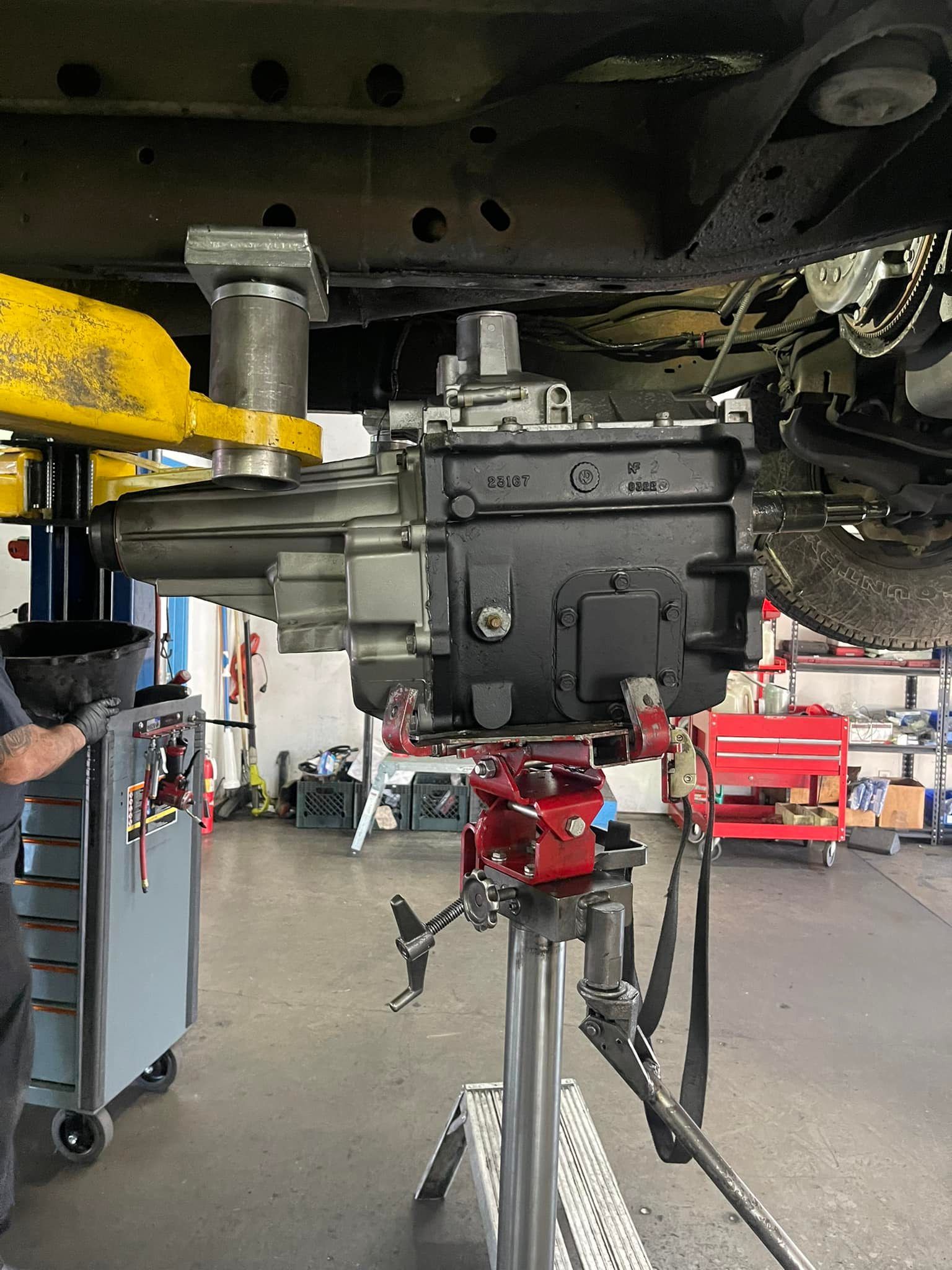
TRANSFER CASE REPAIR & SERVICE
Transfer case fluid change, 4WD service, and transfer case repair for trucks and SUVs in Rohnert Park and Sonoma County.
CALL FOR SERVICE: (707) 584-7727Professional Transfer Case Repair & Service in Rohnert Park, CA
Key Takeaway: Grinding when shifting into 4WD, delayed engagement, or a leak under the cab are the three signs to act on before winter. A transfer case fluid change with inspection catches most of them early. A repair fixes the seal, shift motor, chain, or bearings once they have failed. Book a weekday in September or October, ahead of the December to January rush.
The transfer case is the gearbox behind the transmission on a 4WD or AWD truck or SUV that splits power between the front and rear axles and, on part-time systems, lets you select 2WD, 4WD High, and 4WD Low. Rohnert Park Transmission & Auto Repair services and repairs transfer cases on the trucks and SUVs Sonoma County actually drives: F-150, Silverado, Sierra, Ram 1500, Tacoma, Tundra, 4Runner, Tahoe, Suburban, Expedition, Explorer, Wrangler, Grand Cherokee, and AWD crossovers from Subaru and others.
Transfer case service is maintenance done on an interval: drain and inspect the fluid, check the case and seals for leaks, verify the shift motor or linkage, refill with the manufacturer-specified fluid, and road test every mode. Transfer case repair is what happens after a symptom shows up: grinding or clunking on mode shifts, 4WD that engages late or not at all, a fluid leak under the cab, a whine or vibration that tracks road speed, or a Service 4WD warning. We do both, and every repair starts with a diagnosis that separates the transfer case from the transmission, differentials, driveshaft, and tires, so you pay for the right fix.
Timing matters this year. The NOAA Climate Prediction Center outlook issued in late August 2026 calls for a very strong El Niño with above-normal precipitation odds across coastal California this winter. Trucks that sat in 2WD all summer get asked to engage 4WD cold and wet on the first storm, and that is when neglected fluid, a weeping seal, or a tired shift motor turns into a no-engage problem on a grade. September and October are the right months to book, ahead of the December and January peak when transfer case repair demand climbs and schedules fill.
Our technicians handle manual-lever, electronic push-button and dial-shift, and full-time AWD and 4WD systems. Repairs include output seal and gasket replacement, shift motor and encoder motor replacement, sensor and wiring repair, chain and bearing replacement, mode fork and synchronizer work, and complete rebuilds or remanufactured replacement when the internals are worn. Every job is road tested in each drive mode before the keys come back, and our work is backed by our written warranty.
Transfer Case Service vs. Transfer Case Repair
A quick-lube fluid exchange and a transmission shop repair are not the same job. Use this to decide which one your truck or SUV needs, and if you are not sure, start with the inspection. It is included with the service and it is where most winter 4WD problems get caught early.
- Drain and inspect the old fluid for metal, water, or burnt smell
- Inspect case, output seals, vent tube, and shift linkage or motor
- Refill with the manufacturer-specified fluid to the correct level
- Check tire sizes and wear on AWD and full-time 4WD vehicles
- Road test in 2WD, 4WD High, and 4WD Low where equipped
- Best done on a mileage interval or before a winter trip
- Scan transfer case control module and 4WD codes
- Duplicate the grind, clunk, delay, vibration, or leak on a road test
- Seal, gasket, and slip-yoke repairs for leaks under the cab
- Shift motor, encoder motor, sensor, and wiring repairs
- Chain, bearing, mode fork, and internal gear repair
- Rebuild or remanufactured replacement when internals are worn
Transfer Case Fluid Change Intervals and the Symptoms That Mean You Waited Too Long
Most manufacturers put the transfer case fluid change between 30,000 and 60,000 miles under normal driving, and shorten it to roughly 15,000 to 30,000 miles under severe service. Towing, hauling, dirt and gravel roads, regular 4WD use on wet pavement, and any water crossing all count as severe service. If the fluid has never been changed, or you bought the truck used without records, treat it as due now.
Grinding or clunking when shifting modes
Caught early, this is often thin, contaminated fluid or a slow engagement. Left alone, it becomes a worn mode fork, synchronizer, or chain, and the repair grows with every shift.
Delayed or failed 4WD engagement
On electronic-shift trucks the shift motor, encoder motor, or a corroded connector is the usual cause. We confirm with a scan and a road test before replacing anything.
Leak under the cab
A wet spot under the front seats usually means the rear output seal or the case-to-transmission seam. Transfer cases hold little fluid, so a small leak runs them low fast.
Interactive 3D
See What Your Transfer Case Does in 2H, 4H, and 4L
Drag to turn the truck. Switch drive modes to follow the power through the transfer case, then change the fluid condition to see where the three pre-winter warning signs show up.
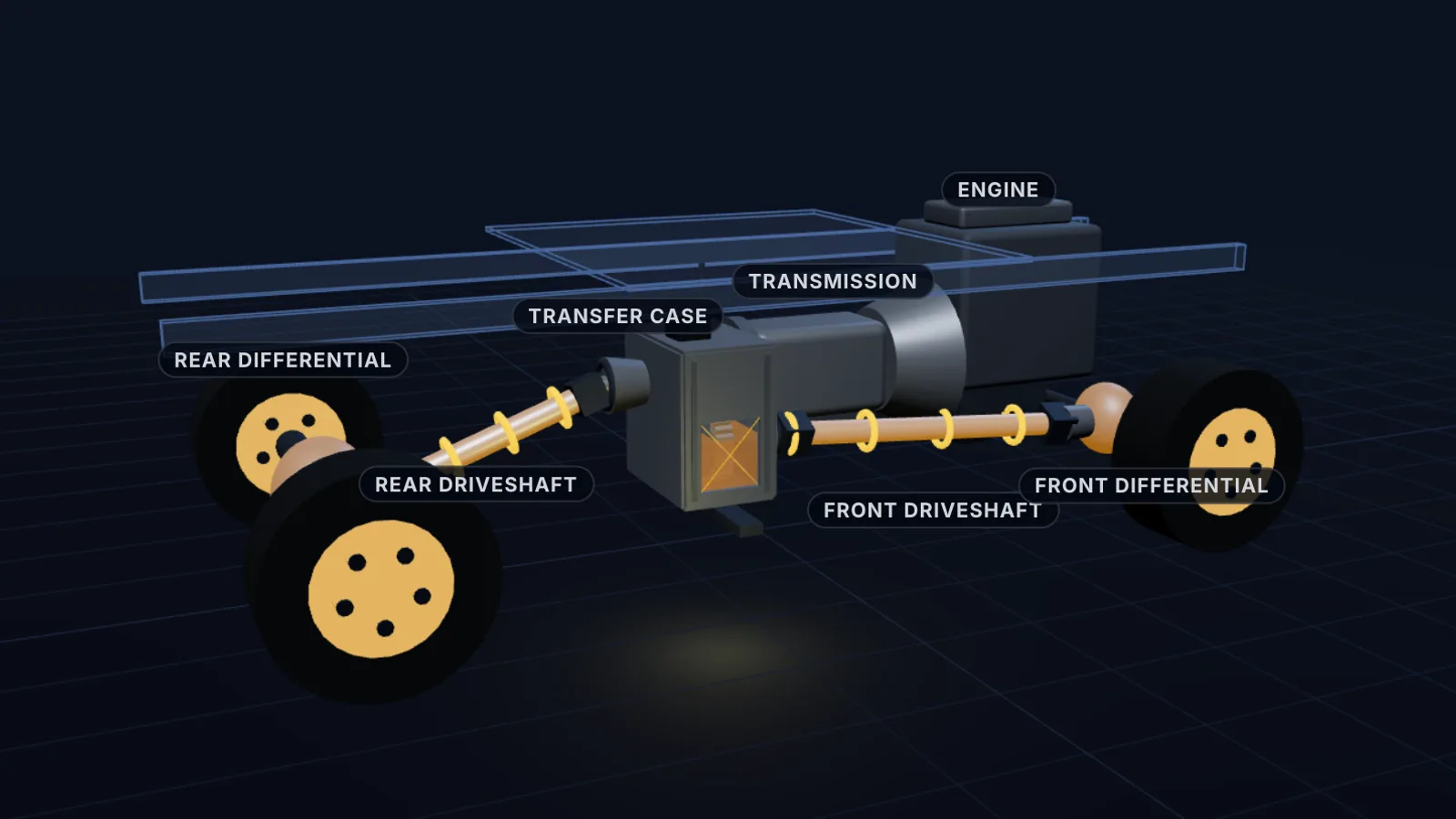
2WD
Power runs from the transmission through the transfer case to the rear driveshaft and rear axle only. The front driveshaft is not driven.
2WD selected. Power runs from the transmission through the transfer case to the rear driveshaft and rear axle only. The front driveshaft is not driven. Fluid condition: fresh.
Drive mode
Fluid condition
Fluid fresh: Manufacturer-specified fluid, filled to the correct level. Transfer cases are not interchangeable on fluid, so the specification is confirmed for your vehicle before the refill.
No warning signs at this fluid condition. Set the fluid to due for service or overdue to see where grinding, delayed engagement, and a leak under the cab come from.
Before the first storm
Seeing one of these on your own truck?
Grinding when you shift modes, 4WD that hesitates to engage, or a wet spot under the front seats are the three signs that mean the fluid waited too long. A transfer case service is the pre-winter check; a diagnosis tells you whether service is enough or a repair is needed.
Why Sonoma County 4WD Owners Should Service Before This Winter
The NOAA Climate Prediction Center's seasonal outlook discussion issued August 20, 2026 states that “El Niño is strengthening, with a greater than 90 percent chance of a very strong event this fall and winter,” and that “probabilities of above normal precipitation were increased significantly to above 50 percent across much of coastal California” for December through February and into early spring. You can read the full discussion on the Climate Prediction Center site.
For Rohnert Park, Cotati, Santa Rosa, and Petaluma drivers, a wet winter means more days when 4WD actually gets used: flooded low spots along the Laguna de Santa Rosa and Stony Point Road, mud on vineyard and ranch roads off Petaluma Hill Road and Sonoma Mountain Road, slick grades on Highway 116 toward the Russian River and Coleman Valley Road to the coast, and chain-control days on Interstate 80 and Highway 50 for anyone heading to Tahoe. A transfer case that sat in 2WD all summer is asked to engage cold and wet, often for the first time in months. That is when delayed engagement, grinding, and a seal that has been weeping all summer turn into a roadside problem.
Our pre-winter 4WD service covers the transfer case fluid and inspection above, plus a check of front and rear differential fluid, driveshaft U-joints and slip yoke, front hub or axle engagement, and tire size match on AWD vehicles. If you also want the transmission serviced before a towing trip, see our transmission service page.
When to Book: Holiday Road Trips and the December to January Peak
September and October: the right window
Weekday appointments are easier to get, parts have time to arrive if the inspection finds a leaking seal or a failing shift motor, and you are not competing with every other 4WD owner who waited for the first storm.
Before a Thanksgiving, Christmas, or ski-week trip
Schedule at least one to two weeks before you leave for Tahoe, Kirkwood, or the Sierra foothills. That leaves time to fix what we find without pushing your departure date.
December and January: the peak
This is when transfer case repair searches climb every year and when trucks come in on a tow hook after 4WD failed to engage on a wet grade. If you are already here, call and we will get you diagnosed as quickly as the schedule allows.
Weekdays only
The shop is closed Saturday and Sunday. Book online for a weekday slot or call during business hours and tell us the year, make, model, and whether the truck is part-time 4WD, full-time 4WD, or AWD.
4WD and AWD Notes for the Trucks and SUVs We See Most
Transfer cases differ by brand in fluid type, shift method, and the parts that fail first. These are the patterns we see most often on the vehicles that come through the shop from Rohnert Park, Santa Rosa, Petaluma, and Sebastopol.
Ford F-150, Expedition, and Explorer
F-150 and Expedition electronic shift-on-the-fly systems depend on the shift motor, hub actuators, and a case that needs the Ford- specified transfer case fluid. Explorer and other Ford crossover AWD models use a power transfer unit that runs hot and holds very little fluid, so we recommend a shorter interval than the owner's manual leads most drivers to expect.
Chevrolet Silverado, Tahoe, Suburban, and GMC Sierra
GM Autotrac cases with the Auto 4WD mode need Auto-Trak II fluid, not a generic ATF, or the clutch pack chatters and the Auto mode shudders. Encoder motor failures and a Service 4WD message are the most common repair. Rear output seal leaks and pump-rub wear on the case are the leaks we watch for on higher-mileage trucks.
Toyota Tacoma, Tundra, and 4Runner
Part-time 4WD Tacomas, Tundras, and 4Runners use a gear oil in the transfer case and are reliable when the fluid is changed on schedule. Full-time 4WD 4Runner Limited models add a center differential with its own lock, so the service and the road test are different. Actuator and vacuum-hub issues show up as delayed front engagement on older Tacomas and 4Runners.
Jeep Wrangler and Grand Cherokee, Ram 1500
Wrangler Command-Trac and Rock-Trac cases and many Ram and Grand Cherokee cases specify ATF+4, and Wranglers that ford water on Sonoma County back roads need the fluid checked for milky contamination after any crossing. Grand Cherokee Quadra-Trac and Quadra-Drive systems combine a transfer case with electronic clutches, so a scan is part of every diagnosis. See our Jeep Wrangler maintenance guide for intervals.
Subaru Outback, Forester, and crossover AWD
Subaru symmetrical AWD has no separate transfer case. The transfer clutch or center differential lives inside the transmission, so a binding or shuddering Subaru in turns is diagnosed through the transmission fluid, the rear differential, and tire size match. Mismatched tires are the single most common cause of AWD damage we see on crossovers, and it is the first thing we check.
Related Drivetrain Reading
Why Choose Our Transfer Case Repair & Service?
- ✓Transfer case fluid change with the manufacturer-specified fluid, not a generic substitute
- ✓Fluid inspected for metal, water, and burnt smell before the refill
- ✓Pre-winter 4WD service: transfer case, differentials, U-joints, hubs, and tire match
- ✓Diagnosis of grinding, delayed engagement, and Service 4WD warnings with a scan and road test
- ✓Leak repair for output seals, case gaskets, and slip-yoke wear under the cab
- ✓Shift motor and encoder motor replacement on electronic-shift trucks
- ✓Chain, bearing, mode fork, and internal repair
- ✓Complete rebuilds or remanufactured replacement when repair no longer makes sense
- ✓Road test in 2WD, 4WD High, and 4WD Low where equipped
- ✓Written warranty on transfer case repairs
Vehicle-Specific Repair Guides
Book Transfer Case Service or Repair in Rohnert Park
Call with the year, make, model, and drivetrain type, or book a weekday online. Tell us whether you are seeing grinding, delayed 4WD engagement, or a leak under the cab, and whether you have a winter trip coming up, and we will schedule the right visit.
CALL US NOW: (707) 584-7727Frequently Asked Questions About Transfer Case Repair & Service
What is the difference between a transfer case service and a transfer case repair?
A transfer case service is maintenance: we drain the old fluid, inspect it for metal and water contamination, check the case, seals, vent, and shift linkage or motor for leaks and play, refill with the exact fluid your manufacturer specifies, and confirm 4WD engages and disengages on a road test. A transfer case repair fixes a failure: a leaking output seal, a shift motor or encoder motor that will not engage 4WD, a stretched chain, worn bearings, a damaged mode fork, or internal gear damage. Service is done on a mileage or time interval. Repair is driven by a symptom, and it always starts with diagnosis so you are not paying for the wrong part.
How often should transfer case fluid be changed?
Most manufacturers land between 30,000 and 60,000 miles under normal use, and several call for a shorter interval, often 15,000 to 30,000 miles, under severe service. Severe service includes towing, hauling, off-road use, frequent 4WD use on wet or muddy roads, and any water crossing. Around Sonoma County, a truck that tows a boat to Lake Sonoma, works vineyard or ranch roads, or makes winter trips over Highway 80 to Tahoe is running severe service. If you do not know when the fluid was last changed, treat it as due.
What are the symptoms of a transfer case that needs service or repair?
The three we see most before winter are grinding or clunking when shifting between 2WD and 4WD, delayed or failed 4WD engagement after you press the button or move the lever, and a fluid leak under the cab, usually at the rear output seal where the driveshaft enters the case. Other signs are a whine that changes with road speed, a vibration under acceleration, binding or hopping in tight turns, and a 4WD or Service 4WD warning on the dash. Grinding and delayed engagement can be fluid-related if caught early. A leak that has run the case low is the fastest path to chain and bearing damage.
Why does 4WD engage late or not at all when it is cold?
On electronic-shift trucks and SUVs, a slow or failed engagement is often the shift motor or encoder motor, its position sensor, a corroded connector, or a mode-select switch. On any transfer case, old fluid that has thickened in cold weather and a mode fork or synchronizer that is worn can cause delayed engagement. Some vehicles also require you to be rolling slowly or stopped in neutral to shift into 4WD Low, so we verify the correct procedure for your vehicle before condemning any part. Diagnosis includes a scan for transfer case control module codes, a fluid check, and a road test in each mode.
What does the leak under my cab mean?
A wet spot near the middle of the truck, roughly under the front seats, is usually the transfer case rear output seal, front output seal, or the seam between the transfer case and transmission. Transfer case fluid is thin, and many cases hold only a couple of quarts, so a slow leak can run the case low quickly. We locate the leak, replace the seal or gasket, check the driveshaft slip yoke that rides in that seal, and refill with the correct fluid. If the fluid shows metal or the case has been run low, we tell you before doing any further work.
When should I book transfer case service before winter in Sonoma County?
Book in September or October, before the first storms and before holiday travel. Search demand for transfer case repair rises through December and January, which is when most drivers discover a problem the first time they need 4WD. If you have a trip planned over Donner Pass or Echo Summit for Thanksgiving, Christmas, or a January ski weekend, schedule the service at least one to two weeks before you leave so there is time to correct anything the inspection finds. The shop is closed on weekends, so plan a weekday visit.
Do AWD vehicles like a Subaru Outback or Ford Explorer have a transfer case?
It depends on the vehicle. Subaru Outback and Forester models route power through a transfer clutch or center differential built into the transmission rather than a separate bolt-on transfer case, so their all-wheel-drive service is tied to the transmission and rear differential fluid. Ford Explorer, Edge, and many crossover AWD systems use a power transfer unit, a small gearbox on the transaxle that runs hot and holds very little fluid, so it benefits from a shorter service interval than most owners expect. Body-on-frame trucks and SUVs such as the F-150, Silverado, Sierra, Tahoe, Suburban, Expedition, Tacoma, Tundra, 4Runner, Ram 1500, Wrangler, and Grand Cherokee use a separate transfer case behind the transmission. We service all of these layouts.
Do you use the manufacturer-specified fluid?
Yes. Transfer cases are not interchangeable on fluid. Many GM Autotrac cases require Auto-Trak II fluid, many Jeep and Ram cases specify ATF+4, several Ford cases call for a Motorcraft transfer case fluid, and most Toyota part-time cases use a gear oil. Putting a generic fluid in the wrong case can cause clutch chatter, shudder in automatic 4WD modes, and premature wear. We confirm the specification for your vehicle and fill to the correct level.
Can I keep driving with a bad transfer case?
It is not recommended. A transfer case that is grinding, leaking, or binding can damage the transmission, driveshafts, U-joints, and differentials, and a failure can leave a 4WD truck without drive to either axle. If the problem is only in 4WD modes, staying in 2WD until the appointment reduces the risk, but do not tow or drive through water in that condition.
Do you repair both electronic-shift and manual-shift transfer cases?
Yes. We service manual-lever cases, electronic push-button and dial-selected cases, and full-time AWD and 4WD systems with automatic modes. That includes shift motor and encoder motor replacement, sensor and wiring repairs, seal and bearing work, chain replacement, and full rebuilds when the internals are worn. When a remanufactured unit is the better route, we tell you why and what changes on the warranty.
How long does a transfer case service take?
A fluid change with inspection is usually completed in the same visit. Seal replacement and shift motor work depend on parts availability for your vehicle. Internal repairs and rebuilds take longer, and we give you the timeline after diagnosis rather than guessing up front.
Have more questions? We're here to help!
Call (707) 584-7727Get In Touch
Related Services
Serving Nearby Cities
We proudly serve customers from throughout Sonoma County
Our Certification

ATRA & ASE Certified for Expert Transmission Service