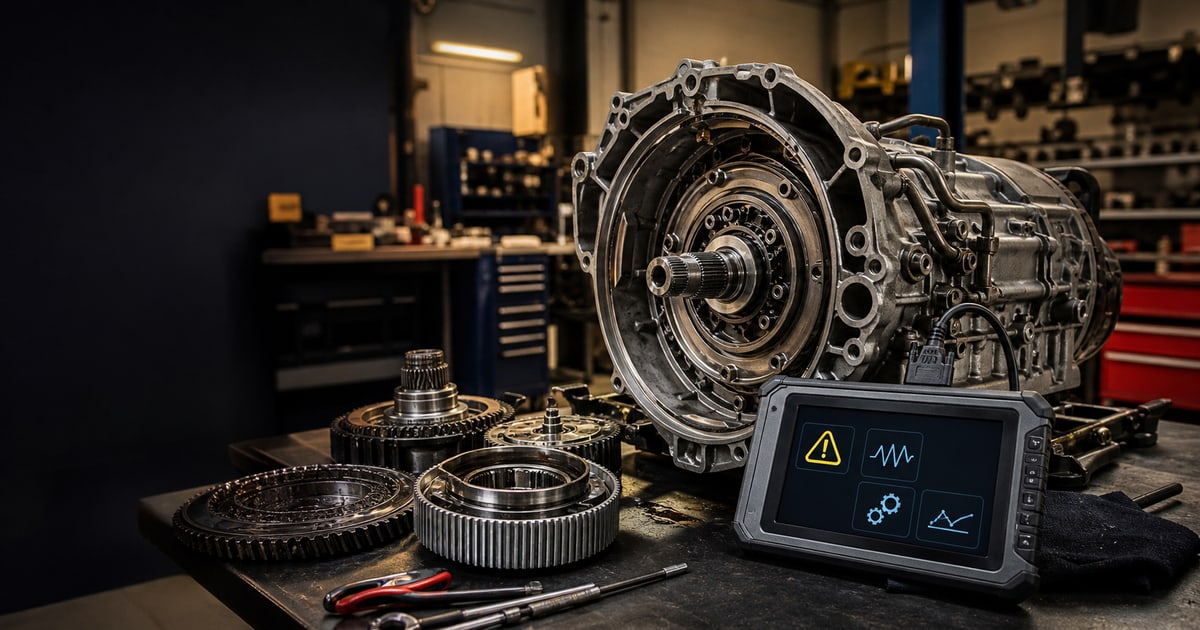
Your transmission did something strange this week. Maybe it slammed into second gear hard enough to rock the whole car, hesitated when you pulled away from a light on Rohnert Park Expressway, or suddenly refused to shift out of third on Highway 101. You scanned the codes or searched the symptoms, and now one part keeps coming up: the transmission control module. This guide explains exactly what a transmission control module is, how to recognize the symptoms of a failing TCM, which trouble codes point to it, and how a transmission specialist decides whether the right fix is a repair, a software reprogram, or a full module replacement.
At Rohnert Park Transmission & Auto Repair, our ATRA and ASE certified technicians diagnose transmission electronics every week — and one of the most expensive mistakes we see is a TCM that was replaced when the real problem was a sensor, a wiring harness, or outdated software. Before anyone sells you a module, read this guide.
What is a transmission control module? Quick answer
The transmission control module (TCM) is the computer that controls your automatic transmission. It reads data from speed sensors, the throttle, the engine, and the transmission fluid temperature sensor, then decides exactly when to shift, how firmly to shift, and when to lock the torque converter. When a TCM fails, the most common results are erratic or harsh shifting, a transmission stuck in one gear (limp mode), failure to shift at all, and a check engine light with codes such as P0700, P0613, P0614, or U0101.
- What it is: the dedicated computer ("brain") of an automatic transmission.
- What it controls: shift timing, shift firmness, line pressure, and torque converter lockup.
- Top failure signs: erratic shifting, limp mode, no upshifts or downshifts, warning lights.
- The fix: reprogram for software faults, replace for hardware faults — after proper diagnosis.
What Does a Transmission Control Module Do?
A modern automatic transmission cannot think for itself. Inside the case there are clutch packs, bands, planetary gears, and a hydraulic valve body — but every decision about when and how to use them comes from the transmission control module. The TCM is a sealed electronic computer that runs the transmission in real time, recalculating its decisions many times per second as you drive.
Dealing with this issue in Sonoma County?
Our ASE and ATRA certified shop team diagnoses the real problem instead of guessing.
Serving the North Bay:
To make those decisions, the TCM constantly reads a network of inputs:
- Input (turbine) speed sensor — how fast the transmission's input shaft is spinning
- Output speed sensor — how fast the output shaft is turning, which corresponds to road speed
- Throttle position and engine load — shared from the engine computer over the vehicle's data network
- Transmission fluid temperature sensor — fluid that is too cold or too hot changes shift strategy
- Transmission range sensor — which position the shifter is actually in (P, R, N, D)
- Brake switch and wheel speed data — used for downshift timing and torque converter control
From those inputs, the TCM commands the outputs that physically make the transmission work: it energizes shift solenoids to route hydraulic pressure to specific clutch packs, modulates the electronic pressure control solenoid to set how firm each shift feels, and engages or releases the torque converter clutch at cruising speed to save fuel. It also compares the input and output shaft speeds on every shift to confirm the transmission achieved the gear ratio it commanded. When the math does not add up, the TCM logs a fault code — that is exactly how slipping is detected and how codes like P0730 (incorrect gear ratio) get set.
One more job matters here: the TCM learns. Modern modules store adaptive values — small corrections that compensate for clutch wear and fluid aging so shifts stay smooth as the transmission ages. This is why a newly replaced or reset TCM often needs a relearn procedure before it shifts correctly.
TCM vs. ECU vs. ECM vs. PCM: What's the Difference?
These four acronyms cause more confusion than any other part of transmission electronics, and getting them straight matters when you are reading scan results or repair estimates.
| Module | Full Name | What It Controls |
|---|---|---|
| ECU | Electronic Control Unit | Umbrella term for ANY computer module in the vehicle — engine, transmission, brakes, body. "The ECU" is not one specific part. |
| ECM | Engine Control Module | The engine: fuel injection, ignition timing, emissions, idle speed. |
| TCM | Transmission Control Module | The automatic transmission: shift timing, shift firmness, line pressure, torque converter lockup. |
| PCM | Powertrain Control Module | A combined unit where the ECM and TCM live in one housing and share a processor — common on many domestic trucks and SUVs. |
Here is the practical version. The ECM runs the engine. The TCM runs the transmission. They talk to each other constantly over the vehicle's data network — for example, the TCM asks the ECM to briefly reduce engine torque during a shift so the clutch packs engage smoothly. On many vehicles the two are merged into a single PCM, and on a growing number of imports and modern designs, the TCM is mounted inside the transmission itself as part of the valve body, an assembly often called a mechatronic unit.
Why does the distinction matter? Because the symptoms overlap. A failing ECM can cause drivability problems that feel like transmission problems, and a TCM fault can cause torque-management behavior that feels like an engine problem. Diagnosing the right module — instead of guessing — is the entire game.
7 Symptoms of a Bad Transmission Control Module, Ranked
These are the bad TCM symptoms we see most often at our shop, ranked from most common to least common. Remember the golden rule: every one of these symptoms can ALSO be caused by sensors, wiring, fluid problems, or mechanical wear. Symptoms tell you something is wrong in the transmission control system — only diagnosis tells you it is the module itself.
1. Erratic or Unpredictable Shifting
The most common sign of a failing TCM is shifting that stops making sense. The transmission upshifts too early or far too late, hunts back and forth between gears, skips gears, or shifts differently under identical driving conditions. One day it drives fine, the next it slams through every shift. Erratic behavior points to the control side of the transmission — the module, its power and ground supply, or its sensor inputs — because mechanical wear tends to produce consistent, repeatable problems, while electronic faults produce random ones.
2. Harsh or Delayed Shifts
A TCM that is failing — or working from corrupted data — can command the wrong line pressure, which makes shifts slam hard or hang noticeably between gears. You may feel a firm clunk on the 1-2 shift, a flare of engine RPM between gears, or a long pause when shifting from Park into Drive or Reverse. Heat-damaged modules often do this intermittently: fine on a cold morning in Cotati, harsh after an hour of stop-and-go on Highway 101.
3. Stuck in One Gear (Limp Mode)
When the TCM detects a fault serious enough that continuing to shift could damage the transmission, it locks the unit into a single gear — usually second or third — and turns on a warning light. This is limp mode (also called failsafe or limp-home mode), and it is a deliberate self-protection strategy, not a random breakdown. Limp mode exists to let you drive at reduced speed to a repair shop. If your vehicle is stuck in one gear with high RPM and sluggish acceleration, the control system has already decided something is wrong.
4. Transmission Will Not Upshift or Downshift
Distinct from full limp mode, a dying TCM can simply fail to command specific shifts. The transmission may refuse to upshift into overdrive on the highway, leaving the engine revving high and burning extra fuel, or refuse to downshift when you stop, causing the vehicle to shudder or stall as you pull away. If the shifts that do happen feel normal but certain gears have gone missing, the control side is a prime suspect.
5. Check Engine Light and Transmission Warning Lights
Nearly every genuine TCM fault announces itself electronically. The module sets a diagnostic trouble code and requests the check engine light through the master code P0700. Some vehicles also display a dedicated transmission warning lamp, a gear-position indicator that flashes, or a "transmission fault" message. Since 1996, every light-duty vehicle sold in the US has been required to support OBD-II diagnostics (per EPA on-board diagnostics requirements), so a proper scan can read what the TCM is complaining about — if the scan tool can talk to the transmission module, which many basic code readers cannot.
6. Worse Fuel Economy
A TCM that shifts late, holds low gears, or refuses to lock the torque converter forces the engine to run at higher RPM than necessary. Most drivers notice it at the pump before they connect it to the transmission. If your fuel economy dropped noticeably and the engine seems to be working harder at cruising speed, have the transmission control system scanned.
7. Intermittent Electrical Gremlins
Failing modules are notorious for heat-sensitive and vibration-sensitive behavior: the problem appears only when the engine bay is hot, only on rough roads, or only after a long drive — then vanishes. Internally, cracked solder joints and degraded circuit boards expand and contract with temperature, making contact intermittently. Intermittent faults are the hardest to diagnose and exactly where guess-and-replace repairs waste the most money.
Transmission Control Module Trouble Codes
These are the diagnostic trouble codes most directly associated with the TCM and its control system. The table tells you what each code means — and just as important, what it usually points to, because most of these codes do NOT automatically mean the module itself is bad.
| Code | Definition | What It Usually Points To |
|---|---|---|
| P0700 | Transmission Control System Malfunction | A master "gateway" code — the TCM found a fault and is requesting the check engine light. The real story is in the companion codes stored in the TCM. |
| P0613 | TCM Processor Fault | An internal processor error inside the module itself. One of the few codes that genuinely points at TCM hardware or corrupted software. |
| P0614 | ECM / TCM Incompatible | The engine and transmission modules do not match — common after a module was replaced without being properly programmed to the vehicle. |
| P0602 | Control Module Programming Error | Missing or corrupted calibration software in the module — often resolved by reprogramming rather than replacement. |
| U0101 | Lost Communication With TCM | Other modules cannot hear the TCM on the data network. Causes range from a dead module to blown fuses, poor grounds, or damaged network wiring. |
| P0706 | Transmission Range Sensor Circuit | The TCM cannot reliably tell what gear position you selected — usually the range sensor or its wiring, not the module. |
| P0730 | Incorrect Gear Ratio | The TCM commanded a gear and the math did not check out — usually slipping, low fluid, or a speed sensor, not the TCM itself. |
| P0750–P0770 | Shift Solenoid A–E Malfunction | A solenoid circuit fault. Usually the solenoid or wiring — but multiple simultaneous solenoid codes can indicate a TCM output driver failure. |
Two patterns from this table are worth committing to memory. First, P0700 by itself never tells you what failed — it tells you to scan the transmission module for the real code. Second, several "solenoid" codes appearing at once is a classic sign the common element failed, and the common element is the module or its power supply. For solenoid-specific diagnosis, see our torque converter lockup solenoid guide.
How We Diagnose a Suspected Bad TCM
Replacing a transmission control module on a guess is one of the most expensive mistakes in auto repair — not just because of the part, but because the symptoms usually persist afterward and the real fault is still there. At our shop at 305 Laguna Dr, TCM diagnosis follows a process designed to rule out everything cheaper first:
Step 1: Full-System Scan, Including the TCM
We scan every module in the vehicle with professional-grade equipment — not just the engine computer. The TCM's own stored codes, pending codes, and freeze frame data (the operating conditions at the moment each fault set) usually narrow the problem dramatically before a single part comes off.
Step 2: Verify Power, Grounds, and Wiring
Get an accurate repair quote — not an internet estimate.
Every vehicle is different. Call for transparent, honest pricing.
Serving the North Bay:
A TCM with a corroded ground, a damaged connector pin, or low supply voltage behaves exactly like a dead TCM. We test the module's power and ground circuits under load and inspect the harness and connectors — including for the rodent damage and connector corrosion we regularly find in Sonoma County vehicles parked outdoors.
Step 3: Check Fluid and Basic Transmission Health
Degraded, low, or contaminated transmission fluid causes erratic shifting that mimics module failure. Fluid condition also tells us whether the transmission has been slipping mechanically — which changes the diagnosis entirely.
Step 4: Road Test With Live Data
We drive the vehicle while streaming live data from the TCM: commanded gear versus actual gear ratio, solenoid commands versus response, line pressure behavior, and sensor plausibility. A sensor feeding the module garbage data is far more common than a module making bad decisions from good data — and live data is how you tell them apart.
Step 5: Check for Software Updates Before Condemning Hardware
Manufacturers regularly release updated TCM calibrations to fix shift quality complaints, harsh engagement, and false fault codes. If the symptoms match a known software issue, reprogramming the existing module is the correct repair — and we check this before recommending any module replacement. Our automotive diagnostics service covers this full process.
TCM Repair vs. Reprogramming vs. Replacement
Once diagnosis confirms the fault really is in the module, there are three paths — and which one is right depends entirely on what failed.
Reprogramming (Reflash)
If the module hardware is healthy but its software is outdated or corrupted, the fix is reprogramming: writing the manufacturer's latest calibration into the existing module. This is the remedy manufacturers themselves use at scale — GM's 2026 recall of full-size SUVs is fixed with updated TCM software (NHTSA recall 26V085), and Nissan ran a voluntary service campaign reprogramming TCMs on certain Sentra and Versa models (campaign NTB15-069). Reprogramming requires the right software access and equipment, and afterward the transmission typically needs an adaptive relearn.
Repair
For some vehicles, specialist electronics services can repair a module at the board level — replacing failed solder joints, drivers, or components. This is genuinely useful on older vehicles where new modules are discontinued, but it is vehicle-specific, adds shipping downtime, and is not the right answer when a quality replacement is readily available.
Replacement
A module with true internal hardware failure — processor faults, water intrusion, burned output drivers — gets replaced. Replacement is never just "swap the box": the new module must be programmed to your vehicle's VIN and calibration, married to the immobilizer system on many vehicles, and put through a relearn procedure so it shifts correctly. Skipping these steps is where the dreaded P0614 (ECM/TCM incompatible) comes from.
What Drives the Cost of TCM Work
Per our shop policy we do not publish prices, because the honest answer is that TCM repair costs vary enormously based on real factors:
- Module location — a TCM on the firewall is a short job; a mechatronic unit inside the transmission requires opening the unit and is a much bigger one
- Programming requirements — manufacturer software licensing, security gateway access on newer vehicles, and relearn time differ by brand
- Parts availability — new, remanufactured, and updated-design modules each price differently, and some older modules are dealer-only or discontinued
- What else the diagnosis found — if the module failed because of a wiring fault or overheating transmission, that root cause must be fixed too
Call us at (707) 584-7727 for a free estimate on your specific vehicle — a ten-minute conversation about your symptoms, year, make, and model gets you a far more useful answer than any national average.
Can You Drive With a Bad TCM?
Short answer: only far enough to get it diagnosed, and sometimes not even that. Here is how to think about it.
If the transmission is in limp mode, the vehicle is drivable by design — at reduced speed, directly to a shop. That is what limp mode is for. Do not commute on it for a week: the module locked the transmission into one gear because it detected a fault, and continuing to drive means continuing to run the transmission hot at high RPM.
If the transmission is shifting erratically, dropping into neutral, or banging into gear unpredictably, treat it as a safety issue and stop driving. Federal safety regulators have treated unexpected transmission behavior as exactly that: FCA recalled roughly 323,000 Jeep Cherokees and related vehicles because a control-system fault could default the transaxle to neutral while driving (NHTSA recall 16V-529), and GM's 26V085 recall addresses a condition that can lock the rear wheels. A vehicle that changes gear states without your input is not a "drive it until payday" problem.
There is also a financial reason to stop: a control fault that lets the transmission slip or engage harshly is physically wearing the clutch packs with every drive. Left long enough, an electronics problem becomes a mechanical one — and at that point you are reading our transmission rebuild vs. replace guide instead of this one.
Can You Reset a TCM Without a Scanner?
This is one of the most-searched TCM questions, so here is the honest answer. Disconnecting the battery for 15–30 minutes clears the adaptive memory on some — mostly older — vehicles. Because the module loses its learned corrections, shifting may feel different or temporarily smoother afterward, which is why the trick has a reputation for "fixing" transmissions.
But understand what it actually does: it erases learned data. It does not repair failed hardware, damaged wiring, a bad sensor, or worn clutches, and on many modern vehicles the TCM stores its data in non-volatile memory that survives a battery disconnect entirely. Worse, clearing codes before diagnosis erases the freeze frame evidence a technician would use to find the real fault, and some vehicles need idle, window, and steering relearns after a battery disconnect. If the problem comes back — and with a genuine fault, it will — you have spent your time hiding the evidence. A proper TCM reset and adaptive relearn is done with a capable scan tool, after the underlying fault is fixed.
Vehicle Makes With Known TCM Problems
Any vehicle can suffer a TCM failure — heat, vibration, and moisture are universal enemies of electronics. But several manufacturers have documented, large-scale TCM issues that are worth knowing about, especially if you are buying used. Every item below is backed by official manufacturer or federal documentation.
Get an accurate repair quote — not an internet estimate.
Every vehicle is different. Call for transparent, honest pricing.
Serving the North Bay:
Ford Focus and Fiesta (DPS6 PowerShift)
The best-documented TCM problem in recent history. Ford extended the transmission control module warranty on 2011–2015 Fiesta and 2012–2016 Focus models with the DPS6 PowerShift dual-clutch transmission to 10 years or 150,000 miles under customer satisfaction program 14M02, covering intermittent loss of transmission engagement, no-starts, and loss of power (Ford program 14M02, NHTSA filing). If you own one of these and the transmission stutters, slips, or dies at intersections, check your coverage before paying for anything. Our shop services these vehicles regularly — see our Ford repair page.
Jeep Cherokee and Chrysler 200 (ZF 9-Speed)
FCA's 9-speed launch years generated multiple control-system actions. The largest, safety recall S55 (NHTSA 16V-529), covered roughly 323,400 vehicles — 2014–2015 Jeep Cherokee plus certain 2015 Chrysler 200, Jeep Renegade, and Ram ProMaster models — where a wiring fault could set a code and default the transaxle to neutral, causing loss of drive. The remedy included reprogramming both the powertrain and transmission control modules (NHTSA recall 16V-529). Early 9-speed vehicles that never got their software updates are still out there shifting badly.
GM Full-Size Trucks and SUVs (10-Speed)
GM's 10-speed transmission has been the subject of repeated control-valve and software actions, most recently recall 26V085 covering 43,732 model-year 2022 Tahoe, Suburban, Yukon, Yukon XL, and Escalade SUVs. The remedy is updated transmission control module software that detects valve wear before it can cause rear-wheel lockup (NHTSA recall report 26V085). We covered this in detail in our GM 2022 SUV transmission recall guide.
Nissan CVT Models
Nissan has issued years of TCM reprogramming campaigns and technical service bulletins for its CVT-equipped models, including voluntary service campaign NTB15-069 reprogramming the TCM on certain 2012–2014 Versa, 2013–2014 Sentra, and 2014 Versa Note vehicles, plus repeated judder-diagnosis bulletins that begin with a TCM software update (Nissan NTB15-069, NHTSA filing). If you drive a CVT-equipped Nissan with shudder or hesitation, software history matters — and so does fluid condition. See our CVT transmission repair service for how we approach these.
Whatever you drive, check your VIN for open recalls and warranty extensions at NHTSA.gov/recalls before paying out of pocket for any TCM work — a surprising number of control-module repairs are covered by programs owners have never heard of.
How Long Does a TCM Last — and Can You Prevent Failure?
A transmission control module is designed to last the life of the vehicle, and most do. The ones that fail early usually die from their environment, not from use. Heat is the number one killer: modules mounted in hot engine bays or inside the transmission itself live a harder life, and an overheating transmission cooks its own electronics. Vibration cracks solder joints over time. Moisture intrusion — flooded floorboards, leaking seals, pressure-washing the engine bay — corrodes circuit boards. Voltage events like improper jump-starts and failing alternators can damage any module in the vehicle.
You cannot make electronics immortal, but you can remove the biggest stressors: keep the transmission fluid serviced so the transmission (and anything mounted to it) runs cooler, fix charging-system problems promptly, and address water leaks before they reach electronics. Regular transmission service is the cheapest insurance the hydraulic and electronic sides of your transmission can get — especially with the stop-and-go Highway 101 commuting and summer heat that Sonoma County drivers put their transmissions through.
Frequently Asked Questions
What does a transmission control module do?
The transmission control module (TCM) is the computer that controls an automatic transmission. It reads input and output speed sensors, throttle position, engine load, and fluid temperature, then commands the shift solenoids, line pressure, and torque converter lockup so the transmission shifts at the right time with the right firmness.
Is a TCM the same as the ECU or ECM?
No. ECU is the umbrella term for any electronic control unit in the vehicle. The ECM (engine control module) runs the engine, while the TCM runs the transmission. Many vehicles combine both into a single PCM (powertrain control module), which is why the terms get confused.
What are the first signs of a bad transmission control module?
The most common early signs are erratic or unpredictable shifting, harsh or delayed gear changes, the transmission getting stuck in one gear (limp mode), failure to upshift or downshift, and a check engine light with codes like P0700, P0613, P0614, or U0101.
Can you drive with a bad TCM?
Only far enough to reach a repair shop. A failing TCM can shift erratically, drop the transmission into neutral without warning, or hold the wrong gear — all of which are safety risks in traffic. If the vehicle is in limp mode, drive cautiously at reduced speed directly to a transmission specialist or have it towed.
Will disconnecting the battery reset a transmission control module?
On some older vehicles, disconnecting the battery clears the TCM's adaptive memory, which can temporarily smooth out shifting. It does not repair a faulty module, a wiring problem, or a mechanical fault, and many newer TCMs store their data in memory that survives a battery disconnect. A proper reset and relearn requires a capable scan tool.
Does a bad TCM always turn on the check engine light?
Usually, but not always. Most TCM faults set codes and request the check engine light through P0700. However, some faults are stored only in the transmission module, and basic code readers that scan just the engine module can miss them. A full-system scan reads the TCM directly.
Can a transmission control module be repaired, or does it need to be replaced?
It depends on the failure. Software problems are fixed by reprogramming the existing module with the manufacturer's updated calibration. True hardware failures usually require replacement, and the new module must be programmed to the vehicle's VIN and put through a relearn procedure. Board-level repair services exist for some modules but are vehicle-specific.
Where is the transmission control module located?
It varies by vehicle. Common locations include the engine bay near the battery or fuse box, behind the dash or kick panel, bolted to the transmission case, or built into the valve body inside the transmission itself (often called a mechatronic unit). Location is one of the biggest factors in how involved a TCM replacement is.
Bottom Line
The transmission control module is the brain of your automatic transmission — and like any brain, it gets blamed for a lot of problems it did not cause. Erratic shifting, limp mode, missing gears, and warning lights all start in the transmission control system, but the module itself is only one suspect among sensors, solenoids, wiring, fluid, and software. The right sequence never changes: scan the TCM directly, verify its inputs and power supply, check for the software updates and warranty programs manufacturers have already published, and only then repair, reprogram, or replace.
If your transmission is acting like its brain is failing, Rohnert Park Transmission & Auto Repair has been diagnosing transmissions — electronic and mechanical — for Sonoma County drivers since 1997. Our ATRA and ASE certified technicians have the transmission-capable scan equipment this work requires. Visit our transmission services hub to see everything we do, or call (707) 584-7727 for a free estimate. We are at 305 Laguna Dr in Rohnert Park, serving Santa Rosa, Petaluma, Cotati, Sebastopol, Windsor, and all of Sonoma County.
Tags:
Written by
Fernando Gomez
Owner, Rohnert Park Transmission & Auto Repair
Fernando brings over 28 years of automotive repair experience to every diagnosis and repair. As the owner of Rohnert Park Transmission & Auto Repair, he leads a team of ASE-certified, ATRA-member technicians specializing in transmission diagnostics, complex drivability issues, and preventive maintenance — with a focus on getting it right the first time.
Need Professional Auto Service?
Trust your vehicle to Rohnert Park's transmission and auto repair experts. We offer comprehensive diagnostics and repairs with a commitment to quality and transparency.
Related Articles
P0700 Code: Transmission Problems Explained
P0700 is the master transmission code the TCM uses to turn on the check engine light. Learn what triggers it and how it is diagnosed.
P0730 Code: Incorrect Gear Ratio and Transmission Slipping Guide
What an incorrect gear ratio code means, how the TCM detects slipping, and when to stop driving.
Torque Converter Lockup Solenoid: Symptoms and Diagnosis
The TCM commands the lockup solenoid. This guide explains how to tell a failed solenoid from a control-side problem.
2022 Tahoe, Yukon and Escalade Transmission Recall: GM 10-Speed Guide
GM recall 26V085 is fixed with updated Transmission Control Module software. See if your full-size SUV is included.
Transmission Shop Serving Santa Rosa, CA
Need TCM or transmission diagnosis near Sonoma County? Our ATRA-certified shop is 12 minutes south of Santa Rosa for automatic, manual, and CVT work.