Sort the Ford Escape by power train complaints at the National Highway Traffic Safety Administration (NHTSA) and the 2010 model year comes out on top, with 513. Many year-by-year lists stop there. We opened the complaints and read them. Only 99 of the 2010 owners describe a transmission problem. 235 of the 513 mention the throttle body, an engine part whose failure made these cars stall and lose power.
So we recounted every model year by what owners actually wrote. Across 22,530 Escape complaints for 2008 through 2026, 2,367 describe the transmission. 1,460 of those, 62 percent, belong to five model years in a row: 2013 through 2017.
Why the 2010 Escape Tops the Wrong List
NHTSA files each complaint under a component tag, and "power train" is a wide net. It takes in the transmission, but also anything that makes the car stop pulling. For the 2009 and 2010 Escape, the dominant story under that tag is a failed electronic throttle body: the wrench light comes on, the engine loses power, and the car limps or stalls.
- 2010 Escape: 513 power train complaints. 235 mention the throttle body. 99 mention the transmission.
- 2009 Escape: 301 power train complaints. 107 mention the throttle body. 72 mention the transmission.
- 2014 Escape, for contrast: 481 power train complaints. 399 narratives across the model year describe the transmission. 2 mention the throttle body.
This matters if you are shopping for a used Escape or trying to work out what is wrong with yours. A 2010 that loses power with a wrench light is more likely an engine-side problem than a failed transmission, and the two repairs have nothing in common. The 2010 record is on NHTSA's vehicle page if you want to read it yourself.
Ford Escape Transmission Complaints by Model Year
Three counts per year: every complaint on file, the ones NHTSA tagged power train, and the ones where the owner's own description mentions the transmission or torque converter. The last column lists the power train recalls that apply to that year. The third count is a keyword match on owner narratives, not a diagnosis, and all complaints are unverified owner reports.
| Model year | All complaints | Tagged "power train" | Narrative describes the transmission | Power train recalls |
|---|---|---|---|---|
| 2008 | 2,417 | 372 | 270 | 15V-606 (replacement units only) |
| 2009 | 1,692 | 301 | 72 | None |
| 2010 | 2,128 | 513 | 99 | 10V-222 |
| 2011 | 1,316 | 268 | 60 | None |
| 2012 | 598 | 66 | 28 | None |
| 2013 | 2,753 | 402 | 256 | 18V-471, 22V-413 |
| 2014 | 2,082 | 481 | 399 | 18V-471, 22V-413 |
| 2015 | 1,091 | 285 | 235 | 22V-254 (2.0L), 22V-413 |
| 2016 | 1,113 | 320 | 289 | 22V-413 |
| 2017 | 2,674 | 390 | 281 | 22V-413 |
| 2018 | 1,787 | 269 | 149 | 22V-413 |
| 2019 | 585 | 125 | 81 | 22V-413 |
| 2020 | 1,523 | 236 | 89 | 20V-550, 21V-011, 24V-330 |
| 2021 | 343 | 43 | 33 | 24V-330 |
| 2022 | 231 | 31 | 14 | 24V-330, 25V-133 |
| 2023 | 95 | 20 | 10 | None |
| 2024 | 76 | 2 | 1 | None |
| 2025 | 23 | 3 | 1 | None |
| 2026 | 3 | 0 | 0 | 26V-301 |
Older model years have had longer to collect complaints, so the newest years will keep filling in. Even so, the shape is plain: one early spike in 2008, a quiet stretch from 2009 to 2012, the main cluster from 2013 to 2017, then a decline with a smaller bump at the 2020 redesign.
Interactive 3D cutaway
Inside the Escape's 6F35 six-speed
The automatic in the 2009-2019 Escape, the years that carry most of the complaints above. Torque converter, three planetary gearsets, five clutches and a one-way clutch, a chain drive and a planetary final drive. The gear ratios, the clutches that apply in each gear and the way the gearsets connect follow Ford's service information.
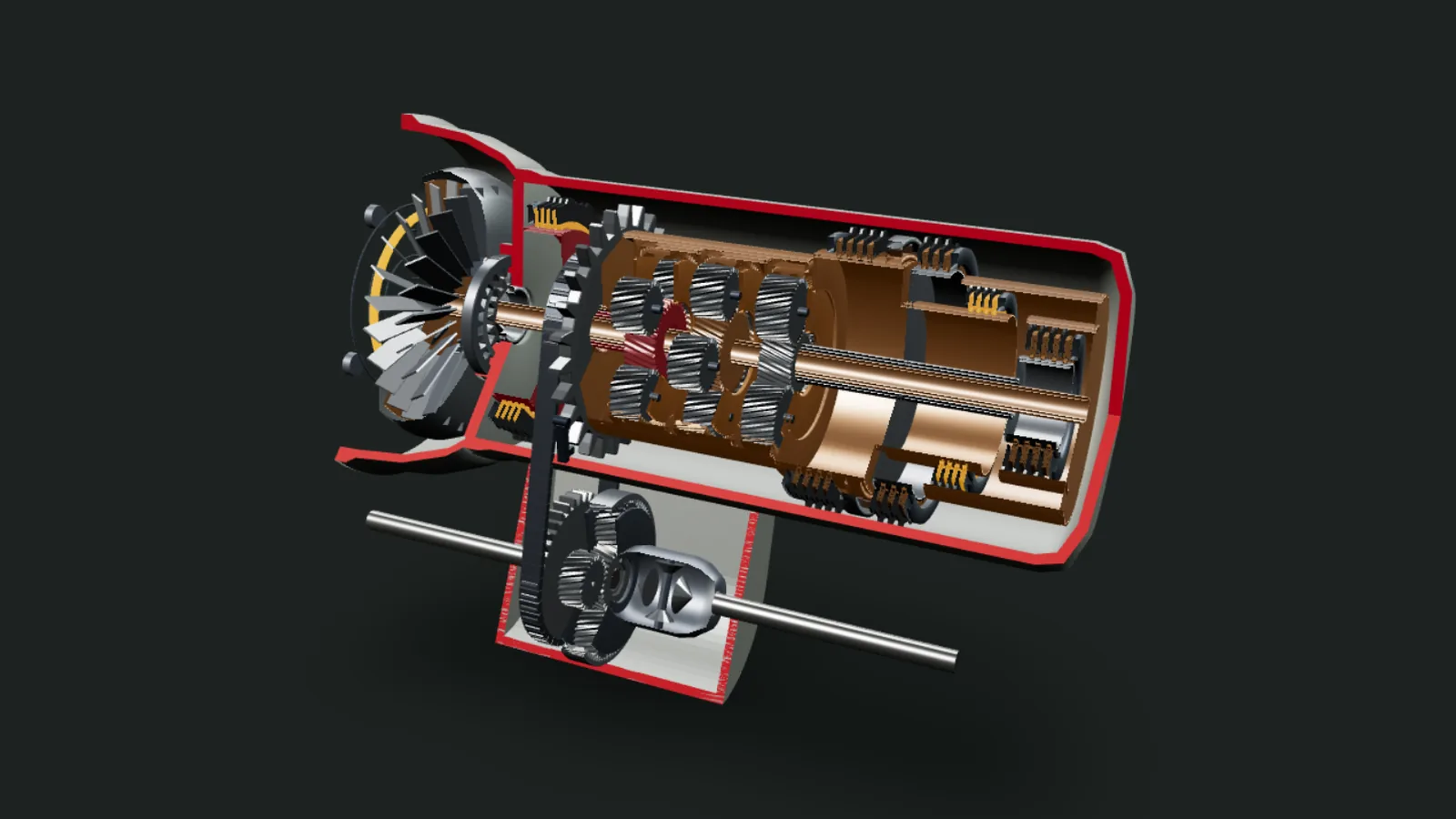
Drive it through the gears, then compare four known 6F35 problems, from a sticking solenoid to the shifter cable recall.
Which clutches make each gear
A dot marks each clutch that is applied. The row for the gear on screen lights up as the model drives.
Swipe the chart sideways to see all six clutches.
| Gear | Ratio | 1-2-3-4 clutch | 2-6 clutch | Low/Reverse clutch | 3-5-R clutch | 4-5-6 clutch | One-way clutch |
|---|---|---|---|---|---|---|---|
| 1st | 4.584 | ||||||
| 2nd | 2.964 | ||||||
| 3rd | 1.912 | ||||||
| 4th | 1.446 | ||||||
| 5th | 1.000 | ||||||
| 6th | 0.746 | ||||||
| Reverse | 2.943 | ||||||
| Park, Neutral | — |
Hollow circle: Low/Reverse also applies in 1st below about 5 mph and in manual Low. Ford's names for the clutches are Forward (1-2-3-4), Intermediate (2-6), Low/Reverse, Direct (3-5-R) and Overdrive (4-5-6), plus the low one-way clutch.
Two holding elements make every gear
Each gear comes from two of the six holding elements: five clutches and a one-way clutch. In 1st the one-way clutch holds the rear carrier, so the 1-2 shift only has to apply the 2-6 clutch. Every other shift releases one clutch while the next one applies. Amber members carry engine torque. Red members are held still, and the gearsets push against them to multiply torque.
What the driver notices: Smooth, quick shifts. Engine speed drops a little at each upshift because the next gear is taller.
What a shop checks: This is the baseline. Compare the other scenarios against it.
Educational model. Ratios, clutch combinations and gearset connections follow Ford's 6F35 service information. Ford does not publish tooth counts, so the gears use counts that give the same ratios, and part sizes and spacing are simplified so every part can be seen. Speeds on screen are slowed, and the pedal and gauges are illustrations, not vehicle readings. It cannot diagnose a car. Never try to recreate a fault while driving.
Escape shifting strangely? Tell us which gear it happens in. That narrows it down fast.
Call (707) 584-7727Book a diagnostic onlineA filing note on the two newest years. NHTSA lists the 2025 gas Escape as "Escape Gas" and the 2026 as "Escape Gas ICE" instead of plain "Escape," so a search on the plain name shows no complaints for either year. The table uses the gas listings. The hybrid and plug-in hybrid are filed separately for those two years and add six more complaints between them, none of which mention the transmission.
2013-2017: The Years That Carry the Complaints
The Escape was fully redesigned for 2013, and transmission complaints jump from 28 for the 2012 model year to 256 for 2013 and 399 for 2014, the highest of any Escape. They stay above 230 every year through 2017.
What separates these from an ordinary shifting complaint is how they end. In the 2014 record, 152 of 399 narratives mention a tow. For 2016 it is 136 of 289. Owners describe driving normally, then losing drive with little or no warning.
What the 2014 narratives mention, out of 399:
- A tow: 152
- The transmission was replaced or a replacement was quoted: 128
- Slipping or RPM rising without speed: 71
- Jerking, clunking or harsh shifts: 62
- The shifter cable or its bushing: 40
- Would not move or would not go into gear: 32
- The torque converter: 26
The replacement count holds across the cluster: 73 for 2013, 82 for 2015, 124 for 2016 and 110 for 2017. None of this was ever the subject of a recall on the transmission itself. The recalls for these years, covered below, all concern a small bushing on the shifter cable. A free bushing repair does not address a transmission that slips or stops driving.
2017 and 2018: Look at the Engine Too
One caution on the later years of that cluster. 50 of the 281 transmission narratives for the 2017 Escape also mention coolant, and under the power train tag it is 98 of 390 for 2017 and 91 of 269 for 2018. Owners in these reports describe an engine losing coolant alongside, or shortly after, transmission trouble.
We are not diagnosing anyone's car from a complaint database. The practical point is narrower: on a 2017 or 2018 Escape, a rough-running engine and a harsh-shifting transmission can show up together, and an engine misfire can feel like a transmission shudder from the driver's seat. Both should be checked before money goes into either one.
2008: Leaks and Cooler Lines
The 2008 Escape is a different car with a different problem. It is the last model year covered by Ford's recall of remanufactured CD4E four-speed transmissions, and its 270 transmission complaints read nothing like the 2014 set.
- A fluid leak: 112 of 270
- The transmission was replaced or a replacement was quoted: 77
- The transmission cooler or its lines: 72
- Slipping or RPM flare: 60
- Harsh shifts: 40
The thread running through these is fluid loss. A transmission that leaks at a cooler line can run low without the driver noticing, and low fluid leads to slipping and heat. On a 2008 Escape still on the road, a look at the cooler lines and the fluid level is the first check, and an inexpensive one. Our guide to low transmission fluid symptoms covers what running low feels like.
The complaint count then drops from 270 for 2008 to 72 for 2009, and 2011 and 2012, at 60 and 28, are the quietest of the older Escapes.
2020 and Newer: A New Design With Its Own Recalls
The 2020 redesign brought 89 transmission complaints for that model year, then 33, 14 and 10 for the three years after. Within the 2020 set, 27 mention a replaced transmission, 24 describe harsh or jerky shifts and 18 describe a shudder.
What sets these years apart is the recall list. The 2020 Escape has two power train recalls of its own, a transmission fluid leak at the start/stop accumulator and a rear drive unit that may be short of lubricant, and the 2020-2022 hybrids have a software recall for shifting into neutral without warning. The newest of these cars may still be within Ford's factory powertrain coverage, so a Ford dealer is the right first stop.
The 2025 and 2026 model years barely have a record yet: 23 and 3 complaints, and a single transmission report between them, a 2025 owner who describes the car shifting on its own, from Drive to neutral and later from Drive to Park, with three dealer visits and no fault found. One report is not a pattern. The 2026 Escape does already have a recall of its own, 26V-301, for a park module that may not lock into Park. It is in the table below, and until the software update is done the parking brake is the safeguard.
Every Transmission-Related Escape Recall, 2008-2026
These are all 10 of the recalls NHTSA files under power train for the 2008-2026 Escape, in plain language. Recall repairs are done by Ford dealers at no charge. On an older Escape, confirm with the dealer that the campaign is still open for your VIN. Ford's customer line on the recall notices is 1-866-436-7332.
| NHTSA recall | Which Escapes | What can happen | Free remedy |
|---|---|---|---|
| 10V-222 (May 2010) | 2010 Escape built Feb 27 to Mar 26, 2010 | A pin that holds the park rod guide may not be installed correctly, so the transmission may not hold in Park. | Dealer repair. |
| 15V-606 (Sept 2015), Ford 15S28 | 2001-2008 Escape that received a remanufactured CD4E transmission rebuilt June 11 to July 15, 2015 | The shift lever bolt on the replacement unit may be loose. The lever can come off the transmission, and the dash may show Park when the transmission is not in Park. | Dealer tightens the bolt or replaces the lever. |
| 18V-471 (July 2018), Ford 18S20 | 2013-2014 Escape with the six-speed automatic | The bushing that attaches the shifter cable to the transmission can degrade and detach. The key can be removed with the transmission not in Park, with no warning chime. | Dealer replaces the bushing. |
| 22V-254 (April 2022), Ford 22S25 | 2015 Escape with the 2.0L engine | Same shifter cable bushing. The car may not go into the gear selected and may roll after Park is selected. | Dealer replaces the bushing and adds a protective cap. |
| 22V-413 (June 2022), Ford 22S43 | 2013-2019 Escape | Same shifter cable bushing, wider population. | Dealer replaces the bushing and adds a protective cap. |
| 20V-550 (Sept 2020), Ford 20S49 | 2020 Escape | Bolts on the start/stop accumulator endcap may be loose or missing. Transmission fluid can leak, leading to loss of drive, and a leak near an ignition source raises fire risk. | Dealer replaces the accumulator. |
| 21V-011 (Jan 2021), Ford 21S02 | 2020 Escape with a rear drive unit | Too little lubricant in the rear drive unit can seize the rear axle. | Dealer checks the level and fills or replaces the unit. |
| 24V-330 (May 2024), Ford 24S33 | 2020-2022 Escape hybrid | Hybrid powertrain control software can shift the car into neutral unexpectedly. | Dealer software update. |
| 25V-133 (Feb 2025), Ford 25S16 | 2022 Escape hybrid repaired incorrectly under 24V-330 | Same neutral-shift software fault, not fixed the first time. | Dealer software update. |
| 26V-301 (May 2026), Ford 25C69 | Certain 2026 Escape | The integrated park module may fail to lock into Park when the driver selects it, so the car can roll away. Expands recall 25V-863. | Software update to a powertrain control module, over the air or at a dealer. Ford mailed interim letters June 5, 2026 and expected the remedy in August 2026. |
Check your own car by VIN at NHTSA's recall lookup. It takes a minute and shows only recalls that have not been completed on that specific vehicle.
The Shifter Bushing: A Small Part With a Rollaway Risk
Three of those recalls, covering 2013-2019 Escapes, come down to one plastic bushing where the shifter cable meets the transmission. When it degrades, the lever in the cabin and the transmission stop agreeing. You can move the shifter to Park and take the key out while the transmission is still in gear or neutral.
- Until the recall is done, set the parking brake every time you park. Ford's own recall notice gives owners the same instruction.
- Be especially careful on a sloped driveway or street, where a car that is not truly in Park will move.
- If the shifter suddenly feels loose or the car will not go into the gear you selected, stop driving it and have it towed.
- If your Escape had the first bushing recall in 2018, check the VIN again. The 2022 recall adds a protective cap and covers more cars.
Before You Approve a Transmission Replacement
128 owners of the 2014 Escape alone told NHTSA about a transmission replacement. Some of those were surely necessary. Before you agree to one, make sure these steps happened.
- The VIN was checked for open recalls. A bushing or software recall will not fix a worn transmission, but it should be done first and it is free.
- The codes were read and written down. A torque converter clutch code, a solenoid code and a gear ratio code point to different repairs. Our P0700 guide explains how the transmission computer reports faults.
- Fluid level and condition were checked. Low, dark or burnt fluid changes the diagnosis.
- Leaks and cooler lines were inspected, above all on a 2008.
- Engine problems were ruled out, above all on a 2009-2010 with a wrench light and on a 2017-2018 that is also losing coolant.
- You were told what failed, not only that the transmission is bad. A shop that has found the fault can name it.
What Moves the Repair Bill
We do not post prices for this work, because the honest figure depends on what the diagnosis finds. On an Escape, these are the things that decide it.
- External or internal. A leaking cooler line, a shifter cable bushing or a software update is a small job. Worn clutches or a failed torque converter means the transmission comes out.
- Rebuild or replace. Rebuilding the transmission that is in the car, fitting a remanufactured unit and fitting a used unit are three different paths with different warranties.
- How far it was driven after it started slipping. Heat and debris spread the damage.
- Front-wheel or all-wheel drive. All-wheel-drive Escapes add parts and labor to removal.
- What the car is worth. On a high-mileage 2013 or 2014, that belongs in the conversation, and we will raise it if you do not.
Call (707) 584-7727 for a free estimate once the problem has been identified.
Recall Work Goes to Ford. The Rest Is Where We Help.
Do not pay any independent shop, including ours, for something a Ford recall covers. The bushing, the accumulator, the rear drive unit and the hybrid software are Ford's to fix at no charge.
What no recall covers is the transmission itself on a 2013-2017 Escape, and that is the work we do every day. Our ASE and ATRA certified technicians at Rohnert Park Transmission & Auto Repair start with the stored codes, the fluid and a road test, then explain what failed and what the options are before any repair begins. If the unit does need to come apart, see how we approach a transmission rebuild. For everything else on the car, see our Ford repair page.
We are at 305 Laguna Dr in Rohnert Park and work on Escapes from across Sonoma County. Call (707) 584-7727 or request an appointment.
Sources
- NHTSA complaint and recall records for the 2008-2026 Ford Escape, pulled September 19, 2026, from NHTSA's public data service. The 2025 and 2026 gas models are filed as Escape Gas and Escape Gas ICE. Vehicle pages: 2010, 2014.
- NHTSA recalls 10V-222, 15V-606, 18V-471, 20V-550, 21V-011, 22V-254, 22V-413, 24V-330, 25V-133 and 26V-301. Recall wording is summarized from NHTSA's published defect descriptions.
- NHTSA recall lookup by VIN.
Tags:
Written by
Fernando Gomez
Owner, Rohnert Park Transmission & Auto Repair
Fernando brings over 28 years of automotive repair experience to every diagnosis and repair. As the owner of Rohnert Park Transmission & Auto Repair, he leads a team of ASE-certified, ATRA-member technicians specializing in transmission diagnostics, complex drivability issues, and preventive maintenance — with a focus on getting it right the first time.
Need Professional Auto Service?
Trust your vehicle to Rohnert Park's transmission and auto repair experts. We offer comprehensive diagnostics and repairs with a commitment to quality and transparency.
Related Articles
Ford Recall 26V402: Transmission Park-Pawl Guide
A separate Ford recall covering F-150, Explorer, Expedition and Lincoln models that may not hold in Park.
P0700 Code: Transmission Problems Explained
The gateway code that says the transmission computer has stored a fault, and how the real cause is found.
Torque Converter Lockup Solenoid Guide
What torque converter clutch faults feel like from the driver's seat and how they are diagnosed.
Low Transmission Fluid: Symptoms and Causes
How a slow leak turns into slipping, delayed engagement and heat damage.