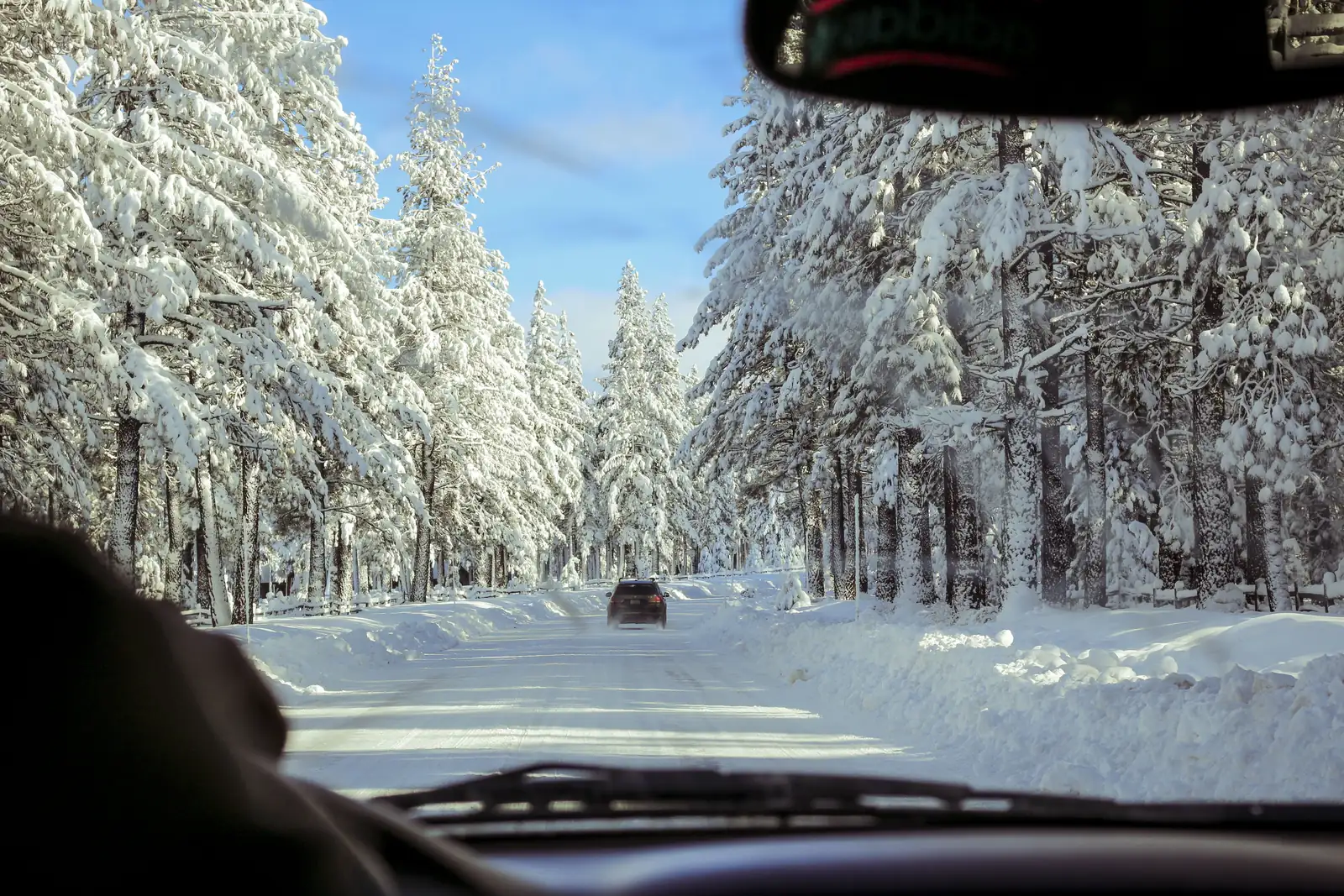
Yes, you need chains with an AWD car in California, at least in the car. Caltrans requires every vehicle entering a chain control area to carry chains. That includes four-wheel and all-wheel drive (Caltrans chain chart).
Whether the chains go on your tires depends on the sign and on your tires. With M+S snow-tread tires on all four wheels, an AWD car can pass an R2 control without chaining up. At R3, every vehicle chains up, with no exceptions (Caltrans).
This guide is written for the Tahoe drive from Rohnert Park and the rest of Sonoma County. It covers the rules, where the checkpoints sit on Interstate 80 and US-50, and what to check on the car before you leave.
Chains on AWD at a glance
- R1: chains required, except passenger vehicles and light-duty trucks under 6,000 pounds gross weight with snow tires on at least two drive wheels. Those must carry chains (Caltrans).
- R2: chains or traction devices required, except four-wheel and all-wheel drive vehicles with snow-tread tires on all four wheels. Those must carry traction devices (Caltrans).
- R3: chains or traction devices on every vehicle, no exceptions. The highway is often closed before R3 (Caltrans).
- Snow-tread tire: MS, M/S, M+S or MUD AND SNOW on the sidewall (Caltrans), with at least 6/32 inch of tread (Caltrans chart).
- Speed limit with chains: 25 or 30 mph (Caltrans).
- Where: I-80 from Applegate (2,020 feet) to the Nevada line, and US-50 from Placerville (2,240 feet) to Echo Summit (Caltrans data). Check QuickMap before you leave.
Heading to Tahoe this winter?
Book the pre-winter 4WD service one to two weeks before you leave. It covers the transfer case fluid, both differentials, the U-joints, hub engagement and tire size match on AWD vehicles.
See what the transfer case and pre-winter 4WD service covers, or check your tires before the trip.
R1, R2 and R3: What Each Sign Means for an AWD Car
California has three levels of chain control. When one is in effect, signs along the road show which level applies (Caltrans). Caltrans says R1 and R2 are the most common. The highway is often closed before R3 is used.
Here is what each level means for an AWD or 4WD car, depending on its tires.
| Sign | AWD or 4WD, M+S on all four tires | AWD or 4WD, no M+S tires |
|---|---|---|
| R1 | Drive on if under 6,000 lb gross weight. Carry chains. | Chains on |
| R2 | Drive on. Carry chains. | Chains on |
| R3 | Chains on | Chains on |
Sources for the table: Caltrans chain controls, Vehicle Code § 27459 and § 27460. Only some tires marked M+S? At R1, snow tires on at least two drive wheels qualify. At R2, an AWD car needs snow-tread tires on all four wheels.
The weight limits in the rules
The exemptions stop at a weight line. Caltrans describes R1 as covering passenger vehicles and light-duty trucks "under 6,000 pounds gross weight." The Vehicle Code sets the snow-tire option at an unladen weight of 6,000 pounds or less (§ 27459). For four-wheel drive with snow-tread tires on all four drive wheels, the line is 6,500 pounds unladen (§ 27460).
Unladen weight means the vehicle equipped and ready for the road, with five gallons of fuel, but without its load (§ 660). Driving a heavy full-size pickup or SUV? Look up its weight before you count on an exemption.
The 4WD exemption comes with conditions
Vehicle Code § 27460 lets a four-wheel drive vehicle with snow-tread tires on all four drive wheels pass a chain sign without chains. It attaches four conditions:
- Traction devices for at least one set of drive wheels must be carried in or on the vehicle.
- The vehicle may not tow another vehicle, except to move a disabled one off the road.
- The tires may not stand in for chains when their stopping, traction and cornering ability is not adequate for the conditions.
- The tires may not stand in for chains where Caltrans or local authorities post signs that require traction devices on these vehicles.
The checkpoint has the last word
- Follow the posted signs and any instructions from Caltrans or CHP staff at the checkpoint, even if a road report says something different (Caltrans).
- Caltrans and the CHP may require chains on all drive wheels if conditions warrant (Caltrans chart).
- Caltrans can keep any vehicle out of a chain control area if it judges the vehicle will have trouble traveling it safely (Caltrans).
- Some local areas use variations of the R1, R2 and R3 designations (Caltrans).
What Counts as a Snow-Tread Tire in California
The exemptions depend on snow-tread tires, so the definition matters. Vehicle Code § 558 calls a snow-tread tire "a tire which has a relatively deep and aggressive tread pattern compared with conventional passenger tread pattern."
In practice, read the sidewall. Caltrans says snow-tread tires carry the letters MS, M/S or M+S, or the words MUD AND SNOW (Caltrans). Vehicle Code § 27459 adds that the tires must be made for use on snow and be in good condition.
Depth counts too. The minimum legal tread depth for mud and snow tires is 6/32 of an inch (Caltrans chain chart).
Check all four tires before the trip:
- Look for the marking on every sidewall. At R2, an AWD car needs it on all four tires.
- Measure the tread on each tire with a tread depth gauge. Each one needs at least 6/32 of an inch.
- Look for damage. The Vehicle Code expects snow-tread tires to be in good condition.
Short on tread, or one tire without the marking? Our tire service page covers new tires, rotation and balancing at the shop.
Why You Still Carry Chains With AWD
AWD does not settle the chain question. California expects chains in the car even when your tires qualify. Here is why that matters on a Tahoe trip:
- Caltrans' chart is direct: "All vehicles, including four-wheel or all-wheel drive vehicles must carry chains upon entering a chain control area" (Caltrans chart).
- The 4WD exemption only works if traction devices for one set of drive wheels ride along (§ 27460).
- Controls change fast. Caltrans says control areas "can change rapidly from place to place." An R2 can become an R3 (Caltrans).
- You cannot buy chains at the checkpoint. Chain installers are not allowed to sell or rent chains (Caltrans).
- Skipping chains when signs require them can get you cited and fined by the California Highway Patrol (Caltrans).
- The law tests stopping and cornering, not just traction. That is the standard in § 27460, and AWD does not change how far a car slides when it brakes on ice.
The chains themselves have to qualify. Vehicle Code § 605 requires every traction device to carry a permanent mark with the maker's name, initials or trademark, and the country where it was made. Caltrans and the CHP can turn away a vehicle whose devices do not meet § 605 (Caltrans chain chart).
Where Chain Controls Go Up Between Sonoma County and Tahoe
From Rohnert Park, both routes to the lake run east through Sacramento. In OpenStreetMap routing, the quickest way from the shop reaches I-80 near Fairfield by Highways 116, 121, 29 and 12. Past Sacramento, I-80 climbs to Truckee and US-50 climbs to South Lake Tahoe.
Caltrans' chain control data lists 18 eastbound control points on I-80, from Applegate to the end of control at the Nevada line. It lists 11 on US-50, from Placerville to Echo Summit (Caltrans chain control data). These are the ones a Sonoma County driver passes most:
Interstate 80 toward Truckee
| I-80 checkpoint | Elevation | Miles from the shop |
|---|---|---|
| Applegate | 2,020 ft | 126 |
| Colfax | 2,421 ft | 133 |
| Nyack | 5,393 ft | 155 |
| Kingvale | 6,076 ft | 169 |
| Castle Peak (holding point) | 7,247 ft | 183 |
| Truckee | 5,905 ft | 184 |
US-50 toward South Lake Tahoe
| US-50 checkpoint | Elevation | Miles from the shop |
|---|---|---|
| Placerville east city limits | 2,240 ft | 129 |
| Pollock Pines (Sly Park) | 3,982 ft | 140 |
| Strawberry | 5,728 ft | 166 |
| Twin Bridges | 6,158 ft | 168 |
| Echo Summit (holding point) | 7,401 ft | 175 |
Checkpoint names and elevations: Caltrans chain control data, read November 9, 2026. Road miles: from the shop at 305 Laguna Dr, measured the same day with OpenStreetMap routing (OSRM) and rounded. Caltrans lists Castle Peak and Echo Summit as holding points.
What this means for the trip:
- The lowest checkpoints sit at 2,020 feet on I-80 and 2,240 feet on US-50. Do not assume chain control waits for the summit (Caltrans data).
- Expect about a mile between the "Chains Required" signs and the checkpoint, to put chains on (Caltrans).
- Pull completely off the road to the right to install chains. Never stop in a traffic lane (Caltrans).
- The roads around the lake have their own control points. The same Caltrans data lists points on Highways 89, 28 and 267 (Caltrans data).
- Check the live map on Caltrans QuickMap, or call the Caltrans Highway Information Network at 800-427-7623. It covers California and western Nevada, including the Lake Tahoe and Reno area (Caltrans).

Which Chains, and Which Wheels, on an AWD Car
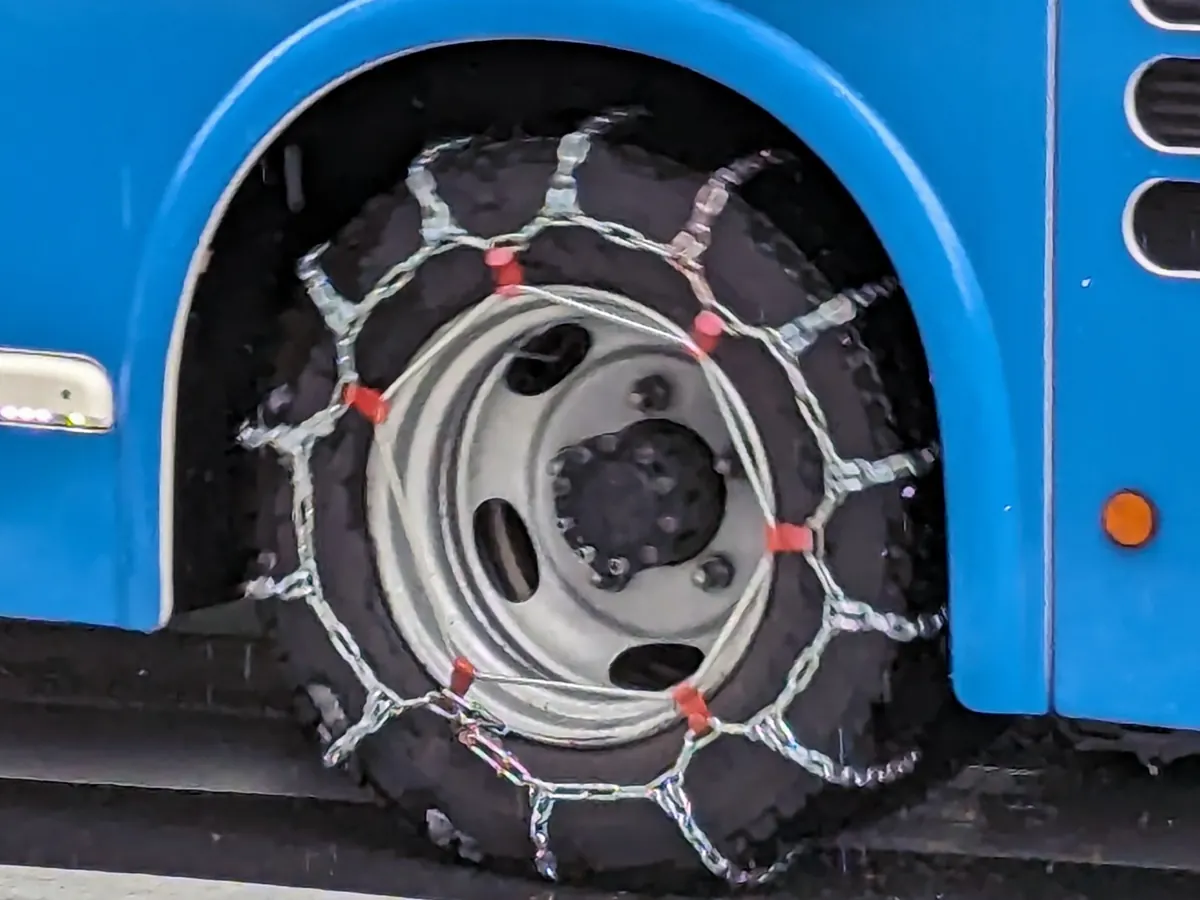
California accepts more than link chains. Caltrans permits link-type chains or alternative traction devices. Its examples are cable chains, textile snow chains, wheel hub attached chains and automatic tire chains (Caltrans chain chart).
- Cable chains and other less conventional devices are legal, but may be restricted at times due to local conditions (Caltrans chart).
- Caltrans does not sell or recommend any brand. It says to check your vehicle manufacturer's specifications for chains and traction devices (Caltrans).
- Chains must be the proper size for your tires and in working order (Caltrans winter tips).
Then the axle. Caltrans says chains go on the drive wheels, and front-wheel drive cars chain the front axle (Caltrans winter tips, chart). An AWD car drives all four wheels, so your owner's manual decides which axle gets chains and what type fits.
Clearance is often the limit. Subaru's own help center says any Subaru from model year 2010 on cannot use tire chains, because there is too little room between the tires and the body. It says another traction device, such as spring chains, may be acceptable if the device maker recommends it for your vehicle. That device must be SAE class S, used on the front wheels only (Subaru).
Read your own manual before you buy. Then fit the chains once at home, in dry weather, so you know they fit and every piece is there.
On the road with chains:
- Keep to the chain speed limit of 25 or 30 mph (Caltrans).
- Take chains off only past the "End of Chain Control" sign, at a pull-off where you can do it safely (Caltrans).
- Chain installers are independent business people, not Caltrans employees. If you use one, get a receipt and write the installer's badge number on it (Caltrans).
Check the Drivetrain and Tires Before You Go
A chain control lane is a bad place to learn that 4WD will not engage. On a part-time 4WD truck, the transfer case may have sat in 2WD since spring. Our transfer case page explains why the first cold, wet engagement is when late engagement, grinding and a weeping seal show up.
Check these a week or two before the trip:
- Every tire carries an M+S or MUD AND SNOW marking, if you plan to use the R2 exemption.
- Every tire has at least 6/32 of an inch of tread.
- All four tires on an AWD car are the same size. Our transfer case page names mismatched tires as the most common cause of AWD damage we see on crossovers.
- On a part-time system, 4WD engages and disengages in every mode.
- There is no wet spot under the front seats, where a transfer case output seal tends to leak.
- The chains or traction devices match your tire size, and you have gloves and a flashlight with them.
Our pre-winter 4WD service covers the items below, as listed on our transfer case page:
- Transfer case fluid and inspection
- Front and rear differential fluid
- Driveshaft U-joints and slip yoke
- Front hub or axle engagement
- Tire size match on AWD vehicles
Schedule it at least one to two weeks before you leave for Tahoe. That leaves time to fix what we find without pushing your departure date. We are open Mon–Thu 7:30 AM – 5:00 PM and Fri 7:00 AM – 3:00 PM. Call (707) 584-7727 for a free estimate.
Before You Leave Sonoma County
Caltrans' winter driving tips, in short (Caltrans):
- Check chain controls, closures and cameras on QuickMap, or call 800-427-7623.
- Keep the gas tank full. A storm can force a detour, a turnaround or a long wait.
- Put a spare car key in your pocket. Caltrans says drivers lock themselves out while putting on chains.
- Carry a flashlight, chain repair links, an ice scraper, a shovel, water, food, warm blankets and extra clothing.
- Allow extra time and start early.
- Stay at least four car lengths behind snowplows.
Quick Answers
Do I need chains with AWD in California?
You need them in the car every time you enter a chain control area (Caltrans chain chart). You need them on the tires at R3, and at R1 or R2 if your tires do not qualify as snow-tread tires.
Do all-season tires count as snow tires for chain control?
Caltrans identifies snow-tread tires by MS, M/S, M+S or MUD AND SNOW on the sidewall (Caltrans). If all four of your all-season tires carry one of those markings and have at least 6/32 of an inch of tread, they match the description Caltrans uses. Without the marking, they do not.
Can I put chains on just one axle of my AWD car?
Follow your owner's manual. It says which axle takes chains, and some manuals allow only certain devices. At the checkpoint, Caltrans and the CHP may require chains on all drive wheels if conditions warrant (Caltrans chain chart).
Are snow socks and cable chains legal in California?
Yes, as alternative traction devices. Caltrans lists cable chains and textile snow chains as examples. They can be restricted at times, and every device must meet Vehicle Code § 605 (Caltrans chain chart).
How fast can I drive with chains on?
The speed limit when chains are required is 25 or 30 mph (Caltrans).
What happens if I don't chain up when the sign says to?
The California Highway Patrol can cite and fine you (Caltrans). Caltrans can also keep a vehicle out of a chain control area.
Sources
- Caltrans, Chain Controls / Chain Installation: R1, R2 and R3, snow-tread tire markings, speed limit, installers, citations, the Highway Information Network.
- Caltrans, Chain Requirements chart (PDF, revised 10/16): carrying chains on 4WD and AWD, alternative traction devices, 6/32 inch tread, chains on all drive wheels.
- Caltrans, Winter Driving Tips: chains on the drive wheels, what to carry, spare key, snowplows.
- Caltrans chain control data, District 3: checkpoint names and elevations on I-80, US-50, and Highways 89, 28 and 267 (read November 9, 2026).
- Caltrans QuickMap: live chain controls, closures and cameras.
- California Vehicle Code § 558 (snow-tread tire), § 605 (tire traction devices), § 660 (unladen weight), § 27459 (traction devices and snow-tread tires) and § 27460 (four-wheel drive exemption).
- Subaru customer help: Can tire chains be used on my Subaru?
- Road miles: OpenStreetMap contributors, routed with OSRM from 305 Laguna Dr, Rohnert Park (November 9, 2026).
Bottom Line
With AWD, the chains usually ride in the car, not on the tires, but they must be there. M+S snow-tread tires on all four wheels, with at least 6/32 of an inch of tread, get an AWD car through R2 within the weight limits. R3 means chains on for everyone. Before the Tahoe trip, call Rohnert Park Transmission at (707) 584-7727 to book the pre-winter 4WD service.
Tags:
Need Professional Auto Service?
Trust your vehicle to Rohnert Park's transmission and auto repair experts. We offer comprehensive diagnostics and repairs with a commitment to quality and transparency.
Related Articles
Transfer Case Service & Repair in Rohnert Park
Grinding, late 4WD engagement or a leak under the cab? What the pre-winter 4WD service covers and when to book it before a Tahoe trip.
Tire Services in Rohnert Park
New tires, flat repair, rotation and balancing at the shop on Laguna Drive.
Differential Service Guide for AWD, 4WD & RWD
How the differentials and the transfer case work together on an AWD or 4WD vehicle, and why their fluid matters.
The Grapevine Test: Is Your Transmission Ready for Holiday Hills?
Long climbs and holiday traffic work a transmission hard. What to check before a mountain trip.