Car Shakes When Braking: 7 Causes and What to Do Next
Brake shudder is more than uncomfortable—it's a warning. From warped rotors to failing wheel bearings, here are the real reasons your car vibrates when you hit the brakes and what each one means for your safety.

Brake rotors, calipers, and pads work together to stop your vehicle—when any component fails, you feel it.
You press the brake pedal and the steering wheel starts shaking in your hands. The faster you were going, the worse it feels. Maybe the whole front end of your car shudders. Maybe the brake pedal itself pulses against your foot in a rhythmic thump-thump-thump. Either way, your car is telling you something is wrong with the braking system—and ignoring it puts your safety at risk.
A car that shakes when braking is one of the most common complaints at auto repair shops across the country. According to the National Highway Traffic Safety Administration (NHTSA), brake-related problems are cited in roughly 22% of all crashes caused by vehicle component failure, making your braking system the single most critical safety system on your vehicle (Source: NHTSA). This guide covers the seven most common reasons your car shakes when braking, how to tell them apart, and when you need professional help.
Why Braking Makes Problems Obvious
When you press the brake pedal, hydraulic pressure forces brake pads against spinning rotors. That contact creates enormous friction and heat—your brakes routinely reach temperatures above 400°F during normal driving and can exceed 900°F during aggressive stops. According to SAE International research, repeated thermal cycling is the primary mechanism that causes rotor distortion in passenger vehicles (Source: SAE International).
Any irregularity in the rotor surface, pad contact, caliper alignment, or wheel assembly gets amplified during braking because the pads are pressing against a surface spinning at high speed. A variation of just 0.0005 inches in rotor thickness—thinner than a sheet of paper—is enough to produce a noticeable pulsation. At 60 mph, your wheels are rotating approximately 850 times per minute. Even a microscopic surface imperfection repeats hundreds of times per minute, turning a tiny flaw into a vibration you can feel throughout the vehicle.
Understanding where you feel the vibration is the first step in diagnosis. Steering wheel shaking almost always points to the front brakes. Brake pedal pulsation typically indicates the rear brakes. Full-body vibration can involve both axles, the suspension, or wheel-related problems. That distinction guides your technician to the right components before a single wrench comes out.
A rotor thickness variation of just 0.0005 inches—thinner than a sheet of paper—produces the pulsation drivers feel as “brake shudder.”
7 Common Causes of Car Shaking When Braking
1. Warped or Unevenly Worn Brake Rotors
This is the most common cause of brake shudder by a wide margin. Brake rotors are precision-machined metal discs that need to be flat and uniformly thick to work properly. Over time, repeated heating and cooling cycles cause the metal to develop thickness variations—what most people call “warped” rotors. Technically, the rotor develops areas that are slightly thicker or thinner than others. When the brake pad sweeps across those uneven areas during braking, it grabs harder at the thick spots and releases at the thin spots, creating the pulsation.
Several driving conditions accelerate rotor warping. Aggressive braking, riding the brakes down long hills, towing heavy loads, and stop-and-go traffic all generate excessive heat. In Sonoma County, drivers dealing with the steep grades along Highway 12 through the wine country hills, the switchbacks on Bodega Highway, and the long descents into Petaluma from the east put significant thermal stress on their brake rotors. Even routine Highway 101 commuting between Santa Rosa and Novato involves enough stop-and-go to accelerate wear.
The Brake Manufacturers Council notes that the average American driver applies their brakes approximately 75,000 times per year (Source: Motorist.org / Brake Manufacturers Council). Each application generates friction and heat. Over tens of thousands of cycles, even quality rotors develop enough thickness variation to produce vibration.
What you will feel: steering wheel shaking or brake pedal pulsation that gets worse at higher speeds. The vibration is rhythmic and directly synchronized with braking—let off the pedal and it stops. In severe cases, you may hear a rhythmic scraping or thumping sound.
2. Worn Brake Pads
Brake pads are designed to wear down over time—they are a consumable component. When they wear past their service limit, several things happen that cause vibration. The pad material becomes too thin to absorb vibration effectively. The metal backing plate behind the pad can contact the rotor, creating grinding and shaking. Uneven pad wear (one side thinner than the other) creates inconsistent contact that produces shudder.
The Federal Highway Administration reports that the average passenger vehicle in the United States travels approximately 14,263 miles per year (Source: FHWA). Most brake pad manufacturers design their pads to last between 30,000 and 70,000 miles depending on the compound and driving conditions. If you are past 50,000 miles on a set of brake pads and experiencing vibration when braking, worn pads should be high on the suspect list.
What you will feel: a rougher, less precise feel when braking, sometimes accompanied by squealing (from the wear indicator) or grinding (metal-on-metal contact). The vibration may be present at all speeds rather than just high speeds, which helps distinguish it from rotor-only problems.
3. Stuck or Seized Brake Calipers
Brake calipers squeeze the pads against the rotor when you press the brake pedal, then release them when you let off. When a caliper seizes—meaning the piston or slide pins stick and fail to retract properly—the brake pad stays partially pressed against the rotor even when you are not braking. This generates constant friction and heat on one wheel, which warps the rotor on that side and creates vibration.
A stuck caliper is particularly dangerous because it creates a pulling effect. When one wheel has more braking force than the others, the vehicle pulls to one side during braking. It also generates excessive heat in the affected wheel—you may notice a burning smell after driving or see one wheel that is noticeably hotter than the others. In extreme cases, the heat can boil the brake fluid in that caliper, causing brake fade or partial brake failure.
What you will feel: vibration combined with the vehicle pulling to one side when braking. You may notice uneven brake pad wear when inspected, a burning smell from the affected wheel, or the vehicle slowing down on its own when you take your foot off the gas.
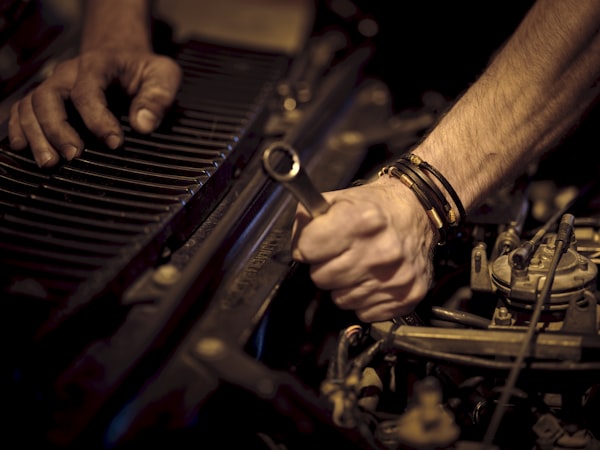
Professional caliper inspection reveals seized pins and uneven pad wear that cause brake shudder.
4. Wheel Bearing Failure
Wheel bearings allow your wheels to spin freely on the axle with minimal friction. When a bearing wears out, it introduces play (looseness) into the wheel assembly. This play allows the wheel to wobble slightly, and that wobble becomes most noticeable during braking because the braking force amplifies any existing looseness in the system.
According to AAA roadside assistance data, wheel bearing failure accounts for a significant portion of roadside breakdowns in vehicles over 75,000 miles (Source: AAA). Bearing wear is gradual. You may first notice a humming or growling noise that changes pitch with vehicle speed and gets louder on turns (the noise shifts as load transfers to the bad bearing during cornering).
What you will feel: a vibration or shimmy during braking, sometimes combined with a humming noise. Unlike rotor issues, a bad wheel bearing often also causes vibration when driving straight at highway speed, not only during braking. Our wheel bearing repair service can diagnose and replace the affected bearing before it becomes a safety hazard.
5. Suspension Component Wear
Your suspension system—ball joints, tie rod ends, control arm bushings, struts, and sway bar links—keeps your wheels precisely positioned relative to the vehicle body. When any of these components develop excessive play from wear, the wheel alignment shifts under the dynamic forces of braking. The weight transfer that occurs during braking loads the front suspension heavily, and worn components allow the wheel to move in ways the engineers did not intend.
The Car Care Council estimates that 85% of vehicles on the road need at least one repair or service, and suspension issues are among the top five most common findings during vehicle inspections (Source: Car Care Council). Suspension wear is often gradual enough that drivers unconsciously adapt to the degraded handling until a noticeable vibration develops.
What you will feel: a less defined vibration that may not be as rhythmic as rotor pulsation. It may feel more like a shimmy or looseness in the front end during braking. You might also notice uneven tire wear, wandering on the highway, or clunking sounds over bumps. Our suspension repair and alignment services can identify exactly which components have worn past their limits.
6. Tire Problems
While tires are not technically part of the braking system, they are the only thing connecting your brakes to the road. Out-of-balance tires, flat spots from hard braking (especially in vehicles without ABS), uneven tread wear from misalignment, and even defective tires with internal belt separation can all produce vibration that becomes more noticeable during braking.
The U.S. Tire Manufacturers Association has documented that internal belt separation is a leading cause of sudden tire failure at highway speeds (Source: U.S. Tire Manufacturers Association). If you feel a rhythmic vibration at highway speed that gets slightly worse during braking, have the tires inspected immediately—this is one cause you do not want to postpone.
What you will feel: vibration that is often present when driving at speed (not only when braking), but intensifies during braking. You may notice a wobble or rhythmic thumping from one corner of the vehicle. Visual inspection may reveal uneven tread wear, bulges, or scalloping patterns on the tire surface.
7. Loose or Over-Torqued Lug Nuts
This is the simplest cause on the list and the most overlooked. If lug nuts are not tightened to the correct torque specification, the wheel can develop a slight wobble on the hub. That wobble amplifies during braking because braking forces act on an already-loose connection. Over-torqued lug nuts are equally problematic—excessive torque can warp the brake rotor by clamping it unevenly against the hub, or it can stretch the wheel studs, creating dangerous looseness over time.
This problem is most common after tire changes, tire rotations, or any service that required wheel removal. If your brake shudder started shortly after having wheel work done, checking lug nut torque should be the first step. A calibrated torque wrench and the manufacturer's spec is all it takes to verify.

Precision measurement of rotor thickness and runout is the fastest way to identify the root cause of brake vibration.
How to Diagnose Which Cause Is Behind Your Brake Shudder
Before spending money on parts, proper diagnosis identifies the actual cause. Here is the systematic approach our technicians follow:
- Where do you feel the vibration? Steering wheel = front brakes. Brake pedal = rear brakes. Entire vehicle = check both axles plus suspension and tires.
- At what speed does it happen? High speed only (above 50 mph) = likely rotor thickness variation. All speeds = caliper, pad, or mechanical issue.
- Does the vehicle pull to one side? Yes = stuck caliper, uneven pad wear, or tire issue on that side. No = more likely a rotor or suspension problem.
- Is there vibration when NOT braking? Yes = likely tire balance, wheel bearing, or suspension rather than brakes specifically.
- When did it start? After wheel work = check lug nut torque. Gradual onset = wear-related (rotors, pads, bearings). Sudden onset = something broke or shifted.
- Any unusual sounds? Grinding = metal-on-metal pad contact. Humming = wheel bearing. Squealing = wear indicator or glazed pads. Clunking = suspension.
A professional diagnostic inspection uses specialized tools—dial indicators for rotor runout, micrometers for thickness variation, and hands-on assessment of caliper function and suspension play—to pinpoint the exact cause without guessing or replacing parts unnecessarily.
What Affects the Repair
The scope and complexity of brake shudder repair depends on several factors:
- Root cause: A simple lug nut retorque is straightforward. Rotor and pad replacement is moderate. Caliper rebuilds, wheel bearing replacement, and suspension work involve more labor and components.
- Vehicle type: Larger vehicles (trucks, SUVs) have bigger brake components. European vehicles often require specific-application parts. Luxury and performance vehicles may use specialized materials.
- Parts quality: OEM-spec or premium aftermarket brake components deliver better performance and longer life than economy parts. We recommend parts that meet or exceed original equipment standards.
- How long the problem has existed: Catching brake shudder early often means resurfacing rotors rather than replacing them. Waiting too long can damage calipers, bearings, and other components that were not part of the original problem.
The most important factor in controlling repair scope is accurate diagnosis. Replacing parts based on guesswork wastes money and often fails to fix the actual problem. Call us at (707) 584-7727 for a professional assessment so you know exactly what your vehicle needs before any work begins.
Can You Drive With Brake Shudder?
This depends entirely on the severity and cause. Mild vibration from early-stage rotor wear is not immediately dangerous, but it will get worse over time. However, several scenarios require immediate attention:
- Severe shaking that makes the vehicle hard to control —stop driving and have the vehicle towed to a shop.
- Grinding sounds during braking —brake pads are metal-on-metal, damaging the rotors with every stop.
- Vehicle pulling hard to one side —stuck caliper or brake imbalance that affects stopping distance and directional control.
- Burning smell from a wheel —overheating brake from a seized caliper. Risk of brake fluid boiling and partial brake failure.
- Brake pedal goes lower than normal —indicates a hydraulic issue in addition to the vibration problem.
If you are unsure whether your brake shudder is safe to drive on, err on the side of caution. Your brakes are the only thing that stops two tons of metal moving at highway speed. A brake inspection gives you a clear answer and a repair plan.
Preventing Brake Shudder
While some brake wear is inevitable, these driving and maintenance habits significantly extend the life of your braking components:
- Avoid riding the brakes downhill. Use engine braking (downshift to a lower gear) on long descents to reduce heat buildup. This is especially important on routes like Highway 12 through Sonoma County wine country and the grades leading into the Petaluma Valley.
- Allow brakes to cool after heavy use. After descending a hill or repeated hard stops, drive at moderate speed for a few minutes before parking. Parking on extremely hot rotors with the pad pressed against them can imprint the pad material onto the rotor surface.
- Follow recommended brake service intervals. Having your brakes inspected annually or every 12,000 miles catches wear before it becomes vibration.
- Use proper lug nut torque after any wheel work. Always use a calibrated torque wrench to the manufacturer's specification. Impact guns without a torque setting can over-tighten and warp rotors.
- Break in new brake pads and rotors properly. New brakes need a bedding-in period: 30 moderate stops from 30 mph without coming to a complete halt, followed by a cool-down drive. Skipping this step leads to uneven pad deposit and premature vibration.
How Rohnert Park Transmission Diagnoses Brake Shudder
When you bring your vehicle to us with a brake vibration concern, our ASE Certified technicians follow a systematic diagnostic process. We start with a road test to experience the vibration firsthand and note the speed, pedal feel, and steering behavior. Then we perform a comprehensive brake inspection:
- Measure rotor thickness at multiple points using a precision micrometer to check for thickness variation
- Measure rotor lateral runout with a dial indicator to check for wobble
- Inspect brake pad thickness, wear pattern, and condition on all four wheels
- Test caliper slide pins and pistons for free movement
- Check wheel bearings for play by rocking the wheel at 12 and 6 o'clock
- Inspect suspension components—ball joints, tie rods, control arm bushings—for wear
- Verify lug nut torque on all wheels
- Inspect tires for wear patterns, balance marks, and internal damage
We serve drivers throughout Sonoma County including Rohnert Park, Santa Rosa, Petaluma, Cotati, Windsor, Sebastopol, Healdsburg, Novato, San Rafael, and surrounding areas. Whether you drive a domestic, Japanese, European, or Korean vehicle, our brake and rotor repair and diagnostic services can get to the bottom of your brake vibration.
Car shaking when you brake? Get it diagnosed.
Our ASE Certified technicians will identify the exact cause of your brake vibration with a professional diagnostic inspection. Serving Rohnert Park and all of Sonoma County.
(707) 584-7727Frequently Asked Questions
Why does my car shake when braking at high speed but not at low speed? This is the classic sign of rotor thickness variation. At low speeds, the slight difference in rotor thickness produces a vibration too subtle to notice. At highway speeds, the wheels are rotating much faster, amplifying the same imperfection into a vibration you can clearly feel. If the shaking only happens above 50 mph during braking, rotor resurfacing or replacement will almost certainly resolve it.
Is it safe to drive if my car shakes when I brake? Mild vibration from early rotor wear is generally not immediately dangerous, but it will worsen over time and can increase stopping distances. If the shaking is severe, the vehicle pulls to one side, you hear grinding, or you smell something burning, stop driving and have the vehicle inspected. Your brakes are the most important safety system on your vehicle.
Can bad wheel alignment cause shaking when braking? Misalignment itself does not directly cause brake vibration, but it contributes indirectly. Misaligned wheels cause uneven tire wear, which creates vibration that intensifies during braking. Misalignment also puts uneven stress on suspension components, accelerating wear that can lead to brake-related shudder. If you notice vibration during braking and uneven tire wear, a wheel alignment should be part of the repair.
How often should I have my brakes inspected? Most automotive experts recommend a brake inspection every 12,000 miles or once per year, whichever comes first. If you drive in heavy stop-and-go traffic, tow frequently, or regularly drive hilly terrain, more frequent inspections—every 6 months—are advisable. Many shops, including ours, inspect brakes as part of routine services like oil changes.
Do I need to replace both rotors if only one is warped? Technically, you can replace just the warped rotor. However, replacing rotors in pairs (both front or both rear) is standard practice because mismatched rotors can cause uneven braking. A new rotor paired with a worn one has different thickness, friction characteristics, and heat capacity. Replacing in pairs ensures balanced braking performance.
Can new brake pads cause shaking? Yes, if the new pads were installed on worn or damaged rotors, or if the pad bedding-in process was skipped. New pads need to gradually build up a transfer layer on the rotor surface through a series of moderate stops. Aggressive braking on new pads before bedding in can create uneven pad deposits that cause vibration. Always follow the break-in procedure after pad installation.
What is the difference between brake shudder and ABS activation? ABS (Anti-lock Braking System) activation produces a rapid pulsing in the brake pedal and sometimes a buzzing or grinding noise from the ABS pump. This is normal and means the system is preventing wheel lockup on slippery surfaces. Brake shudder from a mechanical problem feels different—it is a vibration in the steering wheel or vehicle body, not just the pedal, and it happens on dry roads at normal braking force. If you are unsure which you are experiencing, have a technician evaluate the vehicle.
My car shakes when braking AND when accelerating. What does that mean? Vibration during both braking and acceleration usually points away from the brakes and toward wheel, tire, or drivetrain issues. An out-of-balance tire, worn CV axle, or bad wheel bearing will vibrate regardless of whether you are braking. If the vibration is present at all times but worsens during braking, the issue is likely a wheel bearing or tire problem being amplified by braking forces. Our diagnostic team can isolate the cause with a road test and inspection.