HEAD GASKET REPAIR
Tested before it is quoted: head gasket diagnosis and repair for Rohnert Park, Santa Rosa, Petaluma and the rest of Sonoma County.
CALL FOR SERVICE: (707) 584-7727Professional Head Gasket Repair in Rohnert Park, CA
Key Takeaway: Overheating, coolant disappearing with no drip, sweet white exhaust smoke, or milky oil on the dipstick are the signs to act on. A combustion-gas test, a cooling-system pressure test and a compression or leak-down test show whether the head gasket has failed and which way it is leaking, before anyone quotes a repair. Caught early, it is a gasket job. Driven hot, it becomes a warped head or a damaged engine.
The head gasket is the thin seal, multi-layer steel on most modern engines, between the engine block and the cylinder head. It keeps three things apart: the combustion pressure in each cylinder, the coolant in the water jacket, and the oil in its passages. When it fails it leaks in one of five directions: combustion gas into the coolant, coolant into a cylinder, coolant into the oil, fluid out of the engine, or pressure from one cylinder into the next. Each direction has its own symptoms and its own test.
Rohnert Park Transmission & Auto Repair tests before it quotes. The same overheating and coolant loss can come from a cracked head, a failed water pump, a stuck thermostat or a leaking radiator, and none of those are fixed by a new gasket. Our technicians pressure test the cooling system, use UV dye to trace external leaks, run a chemical combustion-gas test on the coolant, and use compression and leak-down testing to find a cylinder that is not sealing. You get the result and the repair plan before any work starts.
A correct repair is more than the gasket. The cylinder head comes off with the engine cold, the head and block are measured for flatness, a warped or cracked head is machined or replaced, the bolt threads are cleaned, new head bolts are installed where the engine maker requires them, and the cause of the failure is fixed in the same visit. The cooling system is then refilled, bled and pressure tested again. Most head gasket repairs take one to three working days, longer if the head needs machine-shop work.
Which Way Is It Leaking? Symptom, Meaning and Proof
A head gasket seals three things apart: combustion pressure in each cylinder, coolant in the water jacket, and oil in its passages. It can fail between any two of them, or to the outside. Each direction gives a different symptom and needs a different test, so the symptom you describe on the phone tells us which test to run first.
| What you notice | What it usually means | How it is proven |
|---|---|---|
| Overheating on hills or under load, bubbles in the overflow tank | Combustion gas is being pushed into the cooling system | Chemical combustion-gas (block) test, cooling-system pressure test |
| Sweet white exhaust smoke that does not clear, coolant loss with no drip | Coolant is leaking into a cylinder and being burned | Pressure test with no external leak, leak-down test on the suspect cylinder |
| Milky, light-brown oil on the dipstick, oil level rising | Coolant is mixing into the engine oil | Pressure test, oil analysis for antifreeze |
| Wet line or crust at the head-to-block seam, burning smell | The outer edge of the gasket is weeping coolant or oil | Inspection on the lift, UV dye, pressure test |
| Rough idle, misfire codes on two neighboring cylinders | The gasket has failed between two cylinders | Compression test (two neighbors low), leak-down test |
A combustion leak often shows up only under load. The gauge creeps up climbing the Cotati Grade on 101 or towing up Highway 29 toward Lake County, then drops back on the flat. That pattern, plus bubbles in the overflow tank, is worth a combustion-gas test before anything else gets replaced.
Interactive 3D
See Where a Head Gasket Fails and What Each Failure Does
Drag to turn the engine. Pick a failure to watch where the leak goes on the cut-open engine, which symptom it produces, and how a shop proves it before anyone quotes a repair.
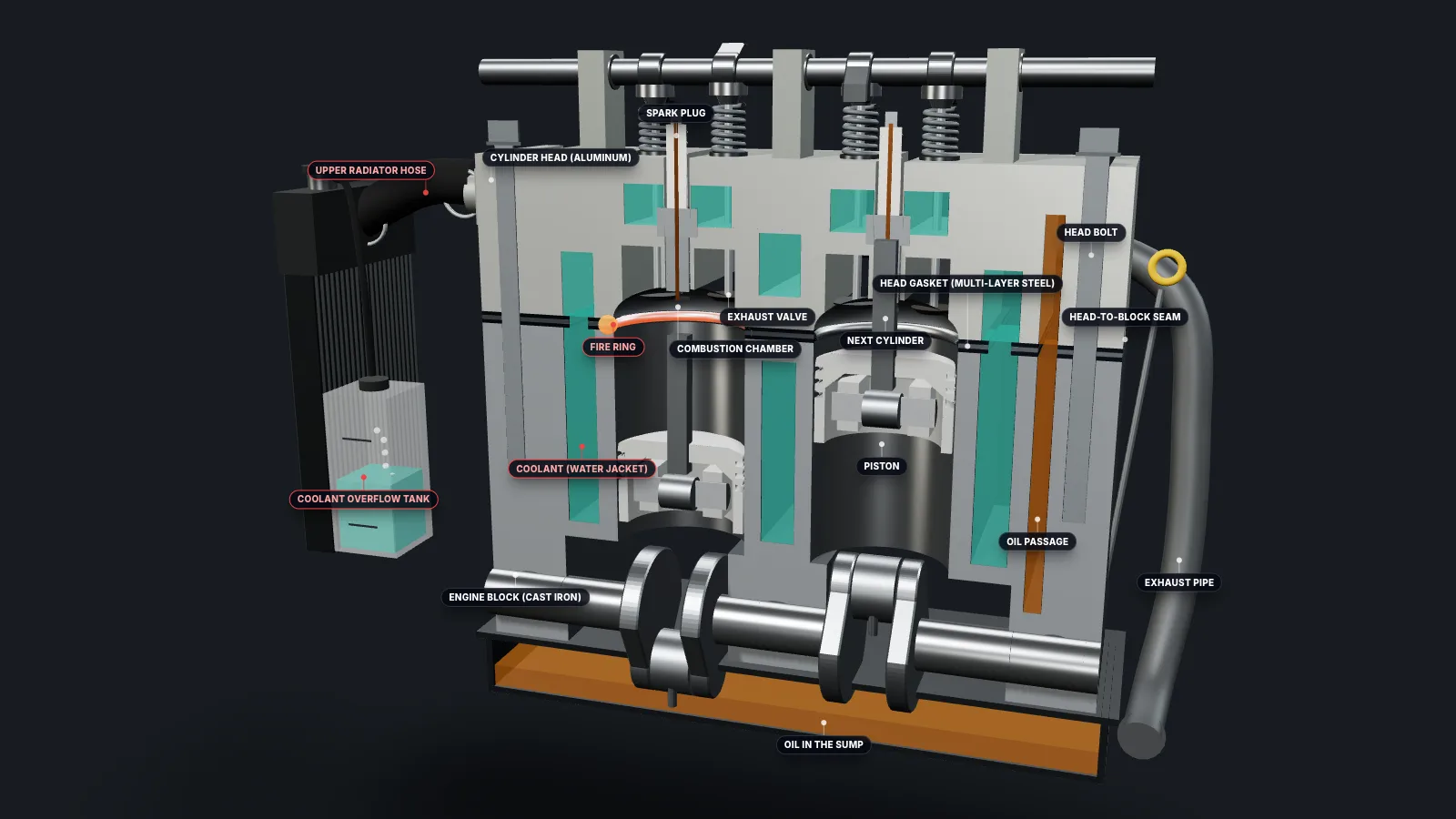
3D engine cutaway showing: Sealed: everything stays in its own passage. The fire ring holds combustion pressure inside the bore. Coolant stays in the water jacket and oil stays in its passages. No leak is drawn. Can you keep driving: no risk.
3D illustration of an inline-four engine cut open at the head gasket. Not a photo of a customer's car.
What is failing
Sealed
Sealed: everything stays in its own passage
The fire ring holds combustion pressure inside the bore. Coolant stays in the water jacket and oil stays in its passages.
What to watch
- Coolant level stays where it was at the last check.
- Temperature gauge sits steady in the middle, on hills and in traffic.
Yes. Nothing here needs attention. Keep an eye on the coolant level and the gauge.
Can You Keep Driving It?
Stop driving
Coolant in the oil, steady white smoke, or a gauge in the red. Coolant in the oil breaks down the oil film and ruins crankshaft bearings. A cylinder that fills with coolant overnight can lock the engine on the next start. Have it towed.
Short trips only
Occasional overheating or bubbles in the overflow tank. Every overheat risks warping an aluminum head, which turns a gasket job into a head job. Drive it only to the shop, with the heater on full and an eye on the gauge.
Book soon, keep it topped up
A slow external weep with a steady gauge. Check the coolant cold every morning. It will not heal, and a low coolant level is how an external leak becomes an overheat.
Blackstone Laboratories, which has analyzed engine oil since 1985, calls antifreeze in the oil the thing that kills more engines than any other, and notes it can be present at trace levels long before you or a mechanic can see it. If the oil looks milky, the damage has already started.
What a Correct Head Gasket Repair Includes
The gasket itself is a small part. The quality of the job is in everything around it. Motor Age editor Mike Mavrigian, who also runs an engine-building shop, puts it plainly: a head gasket is like a fuse, and when it fails, something else usually caused it. A repair that only swaps the gasket often fails again.
- Confirm the failure and find the cause. Test the leak, then check the water pump, thermostat, radiator, fan and coolant condition that may have overheated the engine.
- Remove the cylinder head with the engine cold. Loosening head bolts on a hot aluminum head can warp it.
- Measure the head and block for flatness. A precision straightedge and feeler gauge, checked lengthwise and on both diagonals. A commonly accepted limit for an aluminum head is about 0.002 inch in any direction; the engine maker's specification governs. A head out of spec is resurfaced by a machine shop or replaced, and checked for cracks.
- Clean the surfaces and bolt threads. Threads are cleaned with a thread chaser so the torque reading is real.
- Install the new gasket and new head bolts. Multi-layer steel gaskets go on clean and dry. Torque-to-yield head bolts stretch when tightened and are replaced, then tightened in the maker's sequence to its torque, or torque-plus-angle, specification.
- Refill, bleed and prove it. The cooling system is refilled and bled of air, the fixed cause is rechecked, and the car is road tested and pressure tested again before it goes home.
Two Engines With a Known Head Gasket Pattern
Subaru 2.5-liter (EJ25), about 1999 to 2011
The non-turbo 2.5-liter boxer used in the Outback, Forester, Impreza and Legacy of that era is the Subaru engine most associated with head gasket trouble, and its usual failure is external: coolant or oil weeping from the seam where each cylinder head meets the block, leaving a crust, a sweet or burning smell, and a slowly dropping coolant level. NHTSA's public complaint files hold 134 owner complaints that mention a head gasket for 2000 to 2012 Outbacks and 82 for 1999 to 2010 Foresters. A boxer engine has two cylinder heads, so the job covers both sides, and the leak is easiest to judge with the car in the air.
Toyota Prius, 2010 to 2015 (third generation, 1.8-liter)
NHTSA's complaint files hold 38 owner complaints that mention a head gasket for 2010 to 2015 Priuses and none for the 2004 to 2009 generation. The usual story is a rattle or shake on a cold start, coolant going down with no drip, and sometimes a misfire code on one cylinder. One independent hybrid shop that repairs these engines reports most failures between 130,000 and 200,000 miles. Shops still disagree on the root cause: some blame carbon-clogged EGR ports in the intake manifold, others the gasket itself and the engine's electric water pump. A lasting repair checks the EGR passages, the water pump and the coolant along with the gasket.
Head Gasket Sealer or a Real Repair?
BlueDevil, one of the best-known sealer brands, describes its product as a lifesaver when you have a leak and cannot get the head gasket fixed right away, and tells owners to take the car to a mechanic if the trouble continues after using it. That is the honest use: a way to get home or to the shop. Sealer cannot flatten a warped head, clean antifreeze out of the oil, or fix the water pump or thermostat that overheated the engine. If you have already poured some in, tell us before we test the cooling system.
What Changes the Price
- Engine layout. One cylinder head on an inline four is a smaller job than two heads on a V6, a V8 or a Subaru boxer.
- What sits in the way. Some engines need the timing belt or chain, intake manifold or exhaust manifold removed to reach the head.
- The condition of the head. Flat and uncracked, it goes back on. Warped, it needs machining. Cracked, it needs replacing.
- The cause. A failed water pump, thermostat, radiator or fan gets replaced in the same visit, or the new gasket is at risk.
- How long it was driven. Coolant in the oil for a long time can mean bearing damage, which changes the decision from gasket to engine.
We quote after testing, not before. For the full breakdown of each cost driver, read our head gasket repair cost guide.
Overheating, White Smoke or Milky Oil? Get It Tested First
Call with the year, make, model and mileage, and tell us what you are seeing: overheating, bubbles in the overflow tank, white smoke, milky oil or a leak. If the gauge is in the red, have it towed rather than driven. We are at 305 Laguna Dr in Rohnert Park, Mon–Thu 7:30 AM – 5:00 PM, Fri 7:00 AM – 3:00 PM.
Sources
- Mike Mavrigian, "Cylinder Head Gasket Service In Modern Era Engines," Motor Age / Vehicle Service Pros, January 25, 2021
- Blackstone Laboratories, "Antifreeze: The Silent Killer"
- BlueDevil Products, "What Problems Can Head Gasket Sealant Fix?"
- NHTSA owner complaint files, api.nhtsa.gov complaintsByVehicle, pulled September 29, 2026
- Subaru of Dayton service department, "Head Gaskets, Horizons, and Hope: The Truth About Older Subaru Models"
- Atomic Auto, "Gen 3 Prius Head Gasket Failure: Symptoms & Repair"
- Tucson Hybrids, "Why Prius Head Gaskets Fail: The EGR Cooler Truth"
Why Choose Our Head Gasket Repair?
- ✓The leak is proven before it is quoted: combustion-gas, pressure, compression and leak-down testing
- ✓We look for the cause, not just the failed gasket: water pump, thermostat, radiator, fan and coolant
- ✓Cylinder head and block checked for flatness and cracks before reassembly
- ✓New head bolts where the engine maker calls for torque-to-yield bolts
- ✓Cooling system refilled, bled and pressure tested again before the car goes home
- ✓Honest repair-or-replace advice when the engine has been driven hot or the oil is contaminated
- ✓Subaru, Toyota, Honda, Ford, GM and other makes, including two-head V6, V8 and boxer engines
Vehicle-Specific Repair Guides
Book Head Gasket Testing in Rohnert Park
Call with the year, make, model and mileage and what you are seeing. We will book a diagnosis, test the leak, and give you the repair plan and quote before any work starts.
CALL US NOW: (707) 584-7727Frequently Asked Questions About Head Gasket Repair
What are the signs of a head gasket going?
The signs depend on which way the gasket is leaking. Combustion gas pushed into the cooling system shows up as overheating (often only on hills or under load), bubbles in the coolant overflow tank, and a hard upper radiator hose soon after a cold start. Coolant leaking into a cylinder shows up as sweet-smelling white exhaust smoke that does not clear after warm-up, coolant disappearing with no drip under the car, and a rough start or misfire after the car sits. Coolant leaking into the oil shows up as milky, light-brown oil on the dipstick. An external leak shows up as a wet line or crust where the cylinder head meets the block and a burning smell as it drips onto the exhaust. A leak between two cylinders shows up as a misfire on two neighboring cylinders.
Can you drive a car with a bad head gasket?
Usually not for long, and it depends on the leak. A slow external weep with no overheating can often be driven a short distance while the coolant is kept full and the temperature gauge is watched. Stop driving if the engine is overheating, if there is coolant in the oil, or if the car is blowing steady white smoke: overheating can warp an aluminum cylinder head, coolant in the oil wipes out the crankshaft bearings, and a cylinder that fills with coolant overnight can lock the engine on the next start. If the gauge is in the red, have the car towed rather than driven.
Is it worth fixing a blown head gasket?
It is worth fixing when the rest of the engine is healthy and the cause of the failure can be fixed too. The deciding facts are whether the cylinder head is still flat or can be machined flat, whether the head or block is cracked, the compression on the other cylinders, whether coolant has already damaged the bearings, and what the car is worth to you. A head gasket that failed because a water pump or thermostat let the engine overheat is a good repair once that part is replaced. An engine that was driven for weeks with milky oil may need an engine instead of a gasket. We test first, then give you that decision in writing before any work starts.
How much does it cost to fix a head gasket?
It depends on the engine layout and on what the failure has already damaged, so we do not quote it over the phone. An inline four-cylinder with one cylinder head is a smaller job than a V6, a V8 or a Subaru boxer engine, which have two heads, and some engines need the timing belt or chain removed to reach the head. The price also depends on whether the head needs machining, whether the water pump or thermostat that caused the overheating needs replacing, and whether the oil has been contaminated. Call (707) 584-7727 and we will test the car and quote the actual repair. Our head gasket cost guide explains each of these cost drivers.
How long does a head gasket repair take?
Most head gasket repairs take one to three working days. The time goes into removing the cylinder head, checking the head and block for flatness and cracks, cleaning the surfaces and bolt threads, reassembling with new bolts where the engine maker requires them, refilling and bleeding the cooling system, and a test drive with a recheck. If the head has to be resurfaced at a machine shop, allow extra time for that.
Does head gasket sealer work?
Sealer can hold a small leak long enough to get somewhere, but it is not a repair. Even BlueDevil, one of the best-known brands, describes its sealant as a lifesaver when you cannot get the head gasket fixed right away, and its instructions call for removing the thermostat, flushing the cooling system and idling the engine for 50 minutes. Sealer cannot flatten a warped head, remove coolant that is already in the oil, or fix the water pump, thermostat or radiator problem that overheated the engine in the first place. If you have already used a sealer, tell us, because it will be in the cooling system when we test it.
How do you test for a blown head gasket?
There is no single test for every leak, so we match the test to the symptom. A chemical combustion-gas test (often called a block test) draws air from the radiator or overflow tank through a fluid that changes color if exhaust gas is in the coolant. A cooling-system pressure test holds the system at pressure and shows whether coolant is leaving through an external leak or disappearing inside the engine; UV dye helps find external leaks. A compression test and a leak-down test show a cylinder that is not sealing, and air heard in the radiator or the next cylinder during a leak-down test points at the gasket. Oil analysis can confirm antifreeze in the oil.
Is milky oil under the oil cap always a blown head gasket?
No. A little light froth under the oil filler cap is common on cars that make short trips in cold, damp weather, because moisture condenses and never boils off. That is not the same as milky, light-brown oil on the dipstick, a rising oil level, or coolant that keeps going down. Those point at coolant getting into the oil, which needs testing right away.
Why did my head gasket fail?
Most head gaskets fail because something else went wrong first. Engine builders compare a head gasket to a fuse: when it lets go, look for the cause. The common causes are an overheat from low coolant, a failed water pump, a stuck thermostat, a clogged radiator or a dead cooling fan, followed by a warped cylinder head. Some engines also have a known gasket weakness, such as the older non-turbo Subaru 2.5-liter and the 2010 to 2015 Toyota Prius. A correct repair fixes the cause as well as the gasket, or the new gasket fails the same way.
Can a mobile mechanic fix a head gasket?
It is rarely a good fit for a driveway job. The cylinder head has to come off, the head and block surfaces have to be measured for flatness with a precision straightedge, a warped head has to be machined or replaced, the bolt threads have to be cleaned, and the new bolts have to be tightened in sequence to a torque and angle specification. The cooling system then has to be refilled, bled of air and retested. That work is done best in a shop bay with the tools and a lift, and with a machine shop available.
Have more questions? We're here to help!
Call (707) 584-7727Get In Touch
Related Services
Serving Nearby Cities
We proudly serve customers from throughout Sonoma County
Our Certification

ATRA & ASE Certified for Expert Transmission Service