Most lists of Nissan Rogue years to avoid come from law firm pages, dealer blogs and forum threads, and few of them say where the years came from. This one is counted. We pulled every complaint owners filed with the National Highway Traffic Safety Administration (NHTSA) for the 2008 through 2026 Rogue, 7,211 in all, and read which ones describe the continuously variable transmission (CVT). 1,514 of them do. How those 1,514 split by model year tells a clearer story than any top-five list.
The Short Answer
- Most CVT complaints: 2013 (281), 2011 (173), 2016 (150), 2008 (144) and 2012 (141).
- First generation, 2008-2013: 895 CVT complaints, 59 percent of the total. The common story is losing speed on the freeway.
- Second generation, 2014-2017: 463 CVT complaints. The common story is judder, RPM flare and harsh engagement.
- 2018-2020: 56 CVT complaints across three model years combined.
- 2026, the current model year: 38 complaints so far, 6 of which mention the transmission, and one new recall for a gear indicator that may not display.
- Recalls: no safety recall has ever addressed the CVT failures owners describe in the 2008-2017 cars. Nissan's relief for those came as two warranty extensions, and nearly all of that coverage has now run out by age.
How We Counted
NHTSA publishes every owner complaint with a component tag and the owner's own description. We used both, because the tag alone misleads. The "power train" tag also catches problems that are not the transmission, and many owners who describe a CVT failure file it under "engine" or "unknown."
- All complaints: every complaint on file for that model year, de-duplicated by NHTSA's complaint number.
- Tagged "power train": NHTSA's own component tag.
- Narrative mentions the CVT: the owner's description uses the words transmission, CVT or torque converter. This is a keyword match, not a diagnosis.
Two cautions. Complaints are unverified owner reports, not confirmed defects. NHTSA publishes them as filed. Older model years have also had more time to collect reports, so a 2024 Rogue with 10 is not directly comparable to a 2013 with 281. One filing detail for the newest cars: NHTSA lists the 2026 model year under the names "Rogue ICE" and "Rogue Later Release ICE" instead of plain "Rogue." The two lists share complaint numbers, so we merged them and counted each complaint once. You can read the underlying records yourself on NHTSA's vehicle pages, for example the 2013 Rogue and the 2016 Rogue.
Nissan Rogue CVT Complaints by Model Year
| Model year | All complaints | Tagged "power train" | Narrative mentions the CVT | What stands out |
|---|---|---|---|---|
| 2008 | 429 | 156 | 144 | First model year. Freeway power loss and whine. |
| 2009 | 320 | 101 | 77 | Same pattern, fewer reports. |
| 2010 | 282 | 124 | 79 | Last year named in the 2009 warranty letter. |
| 2011 | 362 | 189 | 173 | Nearly half of all complaints mention the CVT. |
| 2012 | 318 | 136 | 141 | Freeway power loss, recovery after cooling. |
| 2013 | 609 | 314 | 281 | Highest count of any Rogue year. |
| 2014 | 440 | 115 | 93 | Redesign. Judder and harsh engagement begin. |
| 2015 | 553 | 140 | 112 | Judder. Shift-knob recall 15V-775. |
| 2016 | 539 | 176 | 150 | Peak of the second generation. Judder, RPM flare. |
| 2017 | 596 | 122 | 108 | Slip, RPM flare and harsh shifts. |
| 2018 | 609 | 33 | 36 | Sharp drop. Last year in the 2022 extension. |
| 2019 | 334 | 22 | 17 | Few CVT reports. |
| 2020 | 151 | 4 | 3 | Fewest of any year with a full record. |
| 2021 | 286 | 27 | 16 | Third generation begins. |
| 2022 | 258 | 38 | 21 | Few CVT reports. |
| 2023 | 709 | 72 | 47 | Mixed reports. See the 2021-2026 section. |
| 2024 | 199 | 43 | 10 | Record still filling in. |
| 2025 | 179 | 2 | 0 | Record still filling in. |
| 2026 | 38 | 6 | 6 | Current model year. Gear indicator recall 26V-419. |
Read the last two number columns together. In 2011, 173 of 362 complaints, 48 percent, mention the CVT. In 2018 it is 36 of 609, about 6 percent. The 2018 Rogue drew as many complaints overall as the 2013, but they are about other systems.
Explore Rogue CVT symptoms
See how changing a CVT's ratio differs from heat protection, judder and lost drive.
Choose a model year, compare a symptom and change the controls.
Educational schematic. Motion and gauges are relative illustrations, not vehicle readings, failure predictions or a diagnosis. Do not try to reproduce a fault while driving.
Read the explanation and manufacturer sources
Normal operation. A CVT changes its ratio without fixed gear steps. The two pulley running radii change together to vary output speed. The belt shown here explains that principle; construction differs between versions. Nissan explains Xtronic CVTs.
Heat protection. Nissan's 2013 Rogue manual explains that excessive CVT-fluid temperature can trigger reduced engine power and, in some conditions, reduced vehicle speed. This does not establish why a particular car lost power. 2013 Rogue owner's manual, printed page 5-17.
Judder and RPM flare. A shake or engine-speed change is an observation, not a repair verdict. For certain 2014–2017 2.5L Rogues, Nissan specifies complaint, fault-code and inspection criteria. The animation illustrates the sensation, not the diagnostic procedure. Nissan bulletin NTB16-110Q.
Check open safety recalls using the vehicle's VIN at NHTSA's recall lookup. Model year and symptoms alone cannot confirm coverage.
Have a Rogue concern in Sonoma County? Tell our Rohnert Park team when it happens.
Call (707) 584-7727 for a free estimate2008-2013: Losing Speed on the Freeway
The first-generation Rogue carries 895 of the 1,514 CVT complaints, and three model years, 2011 through 2013, carry 595 of them. What sets these years apart is where the failure happens. In the 2013 record, 151 of the 281 CVT complaints mention a highway, freeway or interstate.
The story owners tell is consistent. The car is at steady freeway speed, often on a long grade or a hot day. It stops responding to the pedal, speed falls away, and the driver works over to the shoulder. After sitting for a while it drives normally again. That recover-after-cooling behavior is how a CVT acts when its fluid overheats and the transmission computer cuts power to protect the unit.
What the 2013 narratives mention, out of 281:
- Highway, freeway or interstate: 151
- The transmission was replaced or a replacement was quoted: 94
- Lost speed or would not accelerate: 88
- Warranty: 72
- Slipping or RPM climbing without speed: 59
- Overheating, fail-safe mode or needing to cool down: 53
- Whining or humming: 28
The same profile shows in 2011, where 67 of 173 mention the highway and 67 mention a replaced transmission, and in 2008, where 63 of 144 mention a replacement and 21 mention a whine.
For a Sonoma County driver this pattern matters more than the raw count. A first-generation Rogue that only runs errands around Rohnert Park and Cotati may never show it. The same car held at 65 to 70 on US-101 over the Cotati Grade, or driven inland toward Sacramento in August, is doing exactly what these owners describe just before the power went away.
2014-2017: Judder, RPM Flare and Harsh Engagement
The Rogue was redesigned for 2014, and the complaints change character with it. The freeway power-loss story fades. In its place owners describe a shake or judder under light throttle, RPM that flares without the car speeding up, and a jerk or clunk when the transmission engages.
What the 2016 narratives mention, out of 150:
- Slipping or RPM flare: 55
- The transmission was replaced or a replacement was quoted: 52
- Highway driving: 44
- Jerking, clunking or harsh engagement: 34
- Judder, shudder or vibration: 29
- Overheating or fail-safe mode: 2
Set that last line against 2013, where 53 narratives mention overheating. It is a different failure. Nissan's own 2022 warranty bulletin reflects this: it tells dealers that a control valve body or a belt and pulley kit can be replaced without pre-approval, while a complete CVT assembly needs approval first. In plain terms, Nissan itself treats a part inside the transmission and the whole unit as separate repairs.
That is worth knowing before you accept a quote for a complete transmission on a 2014-2017 Rogue. It may be the right call. It should come after a diagnosis that rules out the smaller repair, not before.
2018-2020: The Numbers Fall Away
CVT complaints drop from 108 for the 2017 model year to 36 for 2018, 17 for 2019 and 3 for 2020. These cars are six to eight years old now, old enough that an early-failure pattern would already be visible in the record. It is not there. On the evidence of NHTSA complaints alone, 2018-2020 are the second-generation years with the least CVT trouble.
A low count is not a clean bill of health for an individual car. A used 2019 Rogue that has never had its CVT fluid serviced is still a risk. The record only says these years do not share the widespread pattern of the earlier ones.
2021-2026: Too Early, With One Year to Watch
The third-generation Rogue has few CVT complaints so far: 16 for 2021, 21 for 2022, 10 for 2024, none yet for 2025 and 6 for 2026. The 2023 model year stands out at 47, within an unusually high 709 complaints overall.
We read the 2023 narratives and they do not describe one problem. Some report a "Service CVT" power-reduced warning, some describe the electronic shifter, and several are engine complaints that mention the transmission in passing. That is too mixed to call a pattern, and many of these cars are still inside Nissan's factory powertrain warranty. If you own one and see a CVT warning, the dealer is the right first stop.
The 2026 Rogue is the model year on sale now, and its record is only months old: 38 complaints, 6 of which mention the transmission. Six reports cannot show a pattern, and they do not describe one problem:
- A "CVT malfunction Service Now" message on the interstate, after the car struggled to hold 45 mph.
- A clunk or jerk when shifting from reverse to drive.
- A car that rolled after being left in Park on a hill.
- A stall at highway speed.
- An engine failure, where the owner adds that the car could no longer change CVT ratios.
- A speedometer fault that appeared after a transmission repair.
Every one of these cars is inside Nissan's factory warranty, and the 2026 model year also has an open recall, covered in the next section. A Nissan dealer is the only place a 2026 Rogue owner should go for any of this.
What Nissan Covered, and What It Did Not
There are two power train recalls in the Rogue's history, and neither addresses the CVT failures described above.
- 15V-775, 2015 Rogue. Covers Rogues built from February 10 to May 13, 2015, where a faulty shift selector knob could let the car be shifted out of Park without a foot on the brake. Dealers inspect and replace the knob at no charge.
- 26V-419, 2026 Rogue. Filed with NHTSA on June 30, 2026. On certain 2026 Rogues the instrument panel may not display the gear selection indicator, so the driver cannot confirm the car is in Park. NHTSA lists unintended movement or a rollaway as the risk. Dealers inspect and, as necessary, replace the transmission control valve assembly at no charge. Nissan mailed owner letters on August 31, 2026, and its number for the recall is PD198.
You can check any Rogue by VIN at NHTSA's recall lookup.
For the CVT itself, Nissan used warranty extensions instead of recalls. We could verify two.
- 2009 extension, 2003-2010 model years. Nissan wrote to owners in late 2009 doubling CVT coverage from 5 years or 60,000 miles to 10 years or 120,000 miles on every 2003-2010 Nissan with a CVT, which includes the 2008-2010 Rogue. The letter is reproduced by Automotive Addicts. By age alone, that coverage ran out around 2021 for the last cars it named.
- 2022 extension, 2014-2018 Rogue. After a class action settlement that a court approved on March 23, 2022, Nissan extended CVT coverage on the 2014-2018 Rogue and the 2015 Rogue Select from 60 months or 60,000 miles to 84 months or 84,000 miles, whichever comes first. Nissan's campaign bulletin lists the CVT assembly and internal parts, gaskets and seals, the control valve body, the torque converter, the cooler kit where fitted, and reprogramming. Hybrids are excluded, and owners who opted out of the settlement may not be covered, per Nissan's dealer notice.
Here is the gap. Neither document we could verify names the 2011, 2012 or 2013 Rogue, the three model years with the most CVT complaints on file. We are not saying no coverage ever existed for those years, only that we could not find a Nissan document that shows it. If you own one, ask a Nissan dealer to run the VIN for open campaigns. It costs nothing.
The calendar matters too. Seven years from the sale date of even the newest covered car, a 2018, ends in 2025 or 2026. As of September 2026, that window has closed or is closing for the last of them. For nearly every 2008-2018 Rogue on the road today, CVT repairs are now the owner's expense.
What to Do If You Own One of These Years
- Run the VIN at NHTSA's recall lookup and ask a Nissan dealer whether any warranty campaign is still open on your car. Do this before paying anyone, including us.
- Find out when the CVT fluid was last changed. If nobody knows, assume it never was. Our CVT maintenance guide explains why fluid condition matters more on a CVT than on a geared automatic.
- On a 2008-2013 Rogue, treat a whine that rises with road speed, or any loss of power on a long freeway pull, as the early warning it is. Stop, let it cool, and have it checked before the next long trip.
- On a 2014-2017 Rogue, note when the judder happens: the speed, light or heavy throttle, cold or warm. That detail shortens the diagnosis.
- If a warning light is on, have the codes read before clearing them. Our guides to CVT warning signs and limp mode explain what the car is telling you.
- Buying used? Ask for service records showing CVT fluid changes, and take a test drive that includes ten minutes at freeway speed, not just a loop around the block.
What Decides the Size of the Repair
We do not publish prices, because an honest number depends on what is actually wrong with your car. These are the factors that move it.
- Which part failed. A control valve body, a belt and pulley set, and a complete CVT assembly are three very different jobs. Nissan's own bulletin treats them separately.
- How long it was driven with the symptom. A CVT that kept running while slipping sheds metal into its fluid, and that contamination can turn a small repair into a full one.
- The replacement unit. New, remanufactured and used transmissions differ in price and in the warranty that comes with them.
- Fluid and cooling. Whether the cooler and lines need flushing or replacing along with the repair.
- The car's mileage and value. On a high-mileage first-generation Rogue, the right answer is sometimes not to repair it, and a good shop will say so.
Call (707) 584-7727 for a free estimate once we know what your Rogue needs.
Where Our Shop Fits
Recall and warranty-campaign work belongs to a Nissan dealer, at Nissan's expense. Do not pay an independent shop to duplicate it. Where an independent transmission shop earns its place is after that coverage has ended, which for the Rogue is now almost every car.
At Rohnert Park Transmission & Auto Repair, a Rogue with a CVT concern starts the same way every time:
- Read the stored codes from the transmission control module, including history codes that no longer light the dash.
- Check CVT fluid level and condition.
- Road test to reproduce the symptom, at the speed and load where you feel it.
- Explain what we found and the repair options before any work begins.
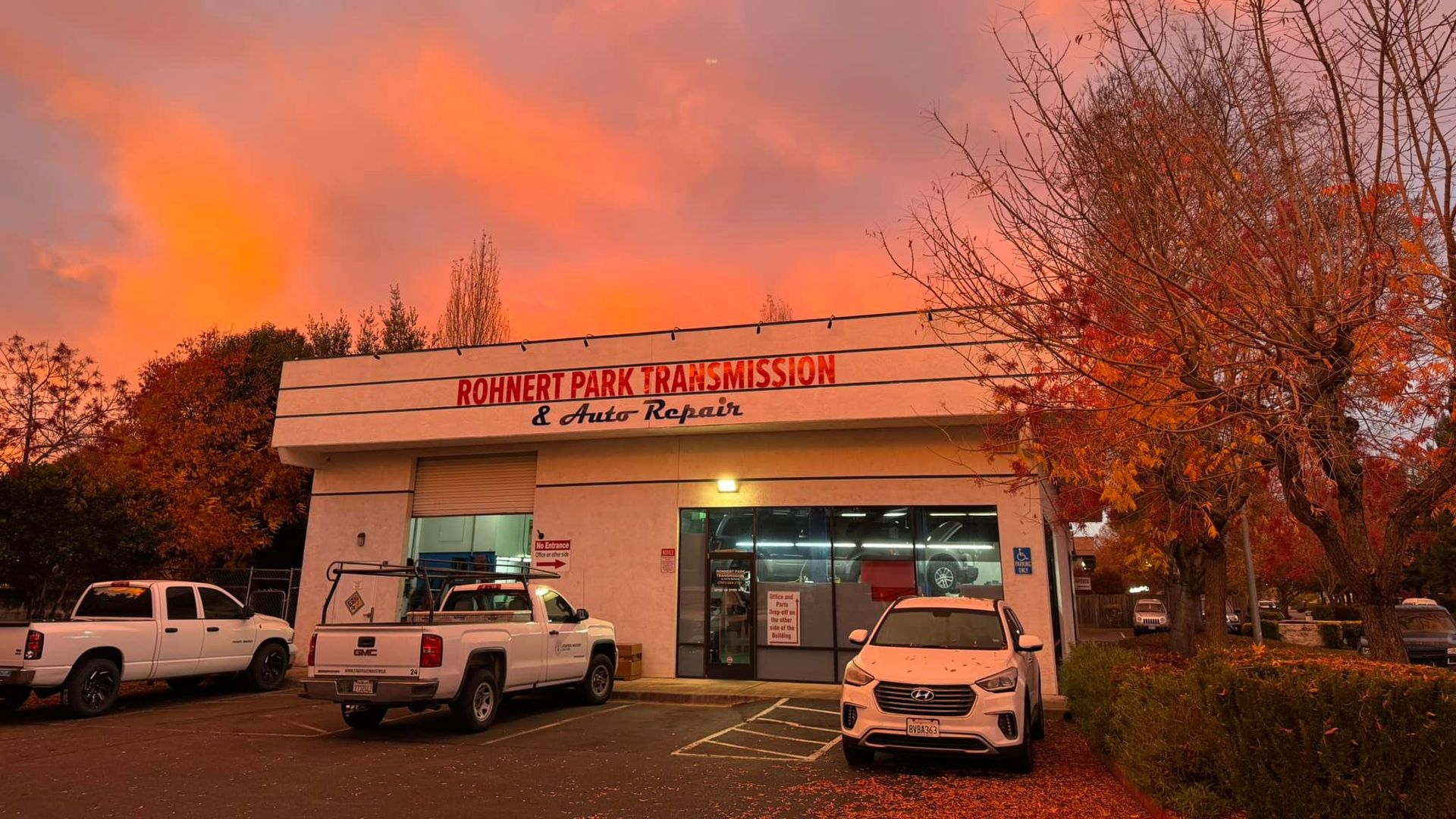
Our ASE and ATRA certified technicians work on Nissan CVTs at 305 Laguna Dr in Rohnert Park. See our Nissan CVT service for how we handle these transmissions, our Nissan repair work for everything else on the car, or the make-wide Nissan CVT problems guide if you drive an Altima, Sentra or Pathfinder instead.
Call (707) 584-7727 or request an appointment to have your Rogue's CVT checked.
Sources
- NHTSA complaint and recall records for the 2008-2026 Nissan Rogue, pulled September 19, 2026, from NHTSA's public data service. The 2026 model year is filed as Rogue ICE and Rogue Later Release ICE. Vehicle pages: 2013, 2016.
- Nissan campaign bulletin, CVT Warranty Extension, revised August 30, 2022: MC-10219015.
- Nissan dealer notice on the class action settlement, March 29, 2022: MC-10211969.
- Nissan's 2009 owner letter on CVT coverage, as reproduced by Automotive Addicts, November 20, 2009.
- NHTSA recall 15V-775, 2015 Rogue shift selector knob.
- NHTSA recall 26V-419, 2026 Rogue gear selection indicator, Nissan PD198.
Tags:
Written by
Fernando Gomez
Owner, Rohnert Park Transmission & Auto Repair
Fernando brings over 28 years of automotive repair experience to every diagnosis and repair. As the owner of Rohnert Park Transmission & Auto Repair, he leads a team of ASE-certified, ATRA-member technicians specializing in transmission diagnostics, complex drivability issues, and preventive maintenance — with a focus on getting it right the first time.
Need Professional Auto Service?
Trust your vehicle to Rohnert Park's transmission and auto repair experts. We offer comprehensive diagnostics and repairs with a commitment to quality and transparency.
Related Articles
Nissan CVT Transmission Problems: The Make-Wide Guide
How Nissan's CVT behaves across the Altima, Sentra, Rogue, Pathfinder and more, and what the warning signs mean.
CVT Warning Signs: The Complete Guide
Whine, judder, RPM flare and delayed engagement: what each CVT symptom points to and how urgent it is.
Car Stuck in Limp Mode: Causes, Symptoms and Fixes
Why a transmission computer cuts power to protect itself, and what to do when it happens on the road.
CVT Maintenance: How to Extend Transmission Life
Fluid condition, heat and driving habits are the three things an owner controls on a CVT.